
%201.svg)


HIPAA Compliance Checklist for 2025

For companies handling critical information, SOC 2 compliance is what earns customer trust. But SOC 2 readiness gets harder with every system and app you add.
SOC 2 compliance software automates the work between audits. It maps controls to the AICPA Trust Services Criteria, pulls evidence from connected systems, runs access reviews, and flags control drift before an auditor does. The report itself comes from a licensed CPA firm, and good software shortens that firm's fieldwork.
SOC 2 compliance platforms automate SaaS security and compliance monitoring, evidence tracking, and reporting. They cut manual work, reduce risk, and keep your business audit-ready all year.
The right platform helps you meet SOC 2 Type 2 requirements with full visibility into your compliance status, so gaps get fixed early.
Here are the top 10 SOC 2 compliance software tools for 2026.
TL;DR
- SOC 2 Type 2 compliance ensures service providers meet strict standards for security, availability, confidentiality, and privacy, ensuring ongoing data protection.
- SOC 2 compliance software automate security monitoring, audit evidence collection, and report generation, making it easier to stay compliant with less effort.
- These platforms provide real-time monitoring and alerts, helping teams take quick action to prevent issues before they arise and maintain SOC 2 readiness.
- Platforms like CloudEagle.ai, Vanta, and Drata automate audit-ready report generation, saving time and reducing stress during audits.
- While some platforms require an upfront cost, they save time and reduce non-compliance risks, helping businesses scale while staying compliant with SOC 2 Type 2 standards.
- Compliance software prepares the evidence, and a licensed CPA audit firm issues the report. Most companies need both.
Looking For The Best SOC 2 Compliance Software in 2026?
Here's what you need to know:
In 2026, SOC 2 compliance software has evolved from passive reporting into a comprehensive engine for automated governance.
Modern platforms manage the entire evidence lifecycle through deep integrations with identity, HR, and procurement tools, delivering audit-ready visibility in days.
To maximize impact, organizations must select platforms based on their specific functional requirements:
- Executive Governance: CIOs and CAIOs require oversight of expanding SaaS footprints and the mitigation of undetected Shadow AI.
- Security Enforcement: CISOs demand automated least-privilege enforcement and proactive entitlement management rather than simple logging.
- Operational Efficiency: IT teams prioritize the elimination of manual compliance tasks through automated provisioning and Slack-native approval workflows.
- Cost Optimization: Procurement and Finance seek contract intelligence to identify redundant controls and reduce unnecessary spend.
What Is Assessed in SOC 2 Compliance?
SOC 2 Type 2 compliance is a security standard that ensures service providers, especially those handling sensitive data, meet strict security, privacy, and operational standards.
Cybersecurity Expert Mary K. Pratt says: "Organizations that want to prove to others and to themselves that they have a solid cybersecurity and data privacy program will undergo a SOC 2 audit. As such, a SOC 2 audit is a big deal, and it’s demanding, and it requires some serious preparation."
Developed by the AICPA, it goes beyond SOC 2 Type 1 by evaluating how well security processes work over a 6-12 month period.
SOC 2 Type 2 assesses five key areas, known as the Trust Service Criteria:
1. Security: Ensures that a company’s systems are protected against unauthorized access, both physical and logical. For a deeper dive into securing your cloud environment, review industry-leading cloud security posture management best practices.
2. Availability: Confirms that services are available as promised, with minimal downtime.
3. Processing Integrity: Verifies that systems are performing their tasks accurately and completely.
4. Confidentiality: Ensures that data is protected from unauthorized access and is handled according to confidentiality agreements.
5. Privacy: Protects personal information, ensuring that it is collected, stored, and used in line with privacy regulations.
Achieving SOC 2 Type 2 compliance is a game-changer for any business, proving to customers and partners that you take data protection seriously with top-notch security measures. It's a must for SaaS companies, financial institutions, healthcare providers, and anyone handling sensitive information, helping build trust and boost your reputation.
Related Article: SaaS Compliance Best Practices To Follow To Be Audit-Ready

Top 10 SOC 2 Compliance Software in 2026
According to reports, automation can cut time-to-compliance by 90% and reduce SOC 2 workload by weeks or months. To stay compliant, it's essential to choose the best platforms that streamline the process.
Here are the top SOC 2 Type 2 compliance platforms:
1. CloudEagle.ai
CloudEagle.ai is an AI Governance, SaaS Security, and Identity Governance platform. It continuously verifies access, enforces least privilege, and controls AI usage across human and non-human identities, so your systems stay compliant with standards like SOC 2, ISO 27001, and others between audits.
Here's how CloudEagle.ai helps enterprises stay compliant:
1. Automated Access Reviews
CloudEagle.ai automates your SOC 2 and ISO 27001 access reviews from one dashboard, so reviewers see every user's roles and permissions across apps without logging into each one. Each review campaign records who approved or revoked access, which is the trail a SOC 2 auditor samples.
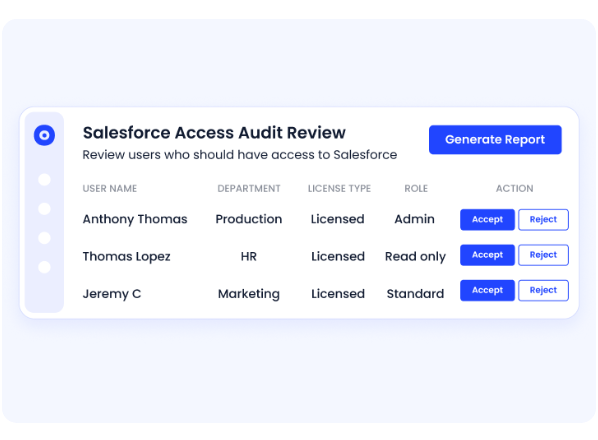
How it helps:
- Flags high-risk users and ex-employees for immediate action.
- Runs reviews continuously instead of once a quarter.
- Attaches deprovisioning proof to every removed user automatically.
Reviews close in days, with evidence your auditor can sample directly.
Discover how Dezerv automated its app access review process with CloudEagle.ai.
2. Joiner-Mover-Leaver Automation
SOC 2 auditors test whether access is granted, changed and removed on time. CloudEagle.ai automates joiner-mover-leaver workflows from your HRIS, so access follows the employee from first day to last, including removing access when employees leave.
How it helps:
- Grants role-based app access before a new hire's first login.
- Removes access that no longer fits after a move or promotion.
- Deactivates accounts across apps as soon as someone leaves.

Your leaver sample comes back with no orphaned accounts.
Know how Treasure Data streamlined employee offboarding using CloudEagle.ai.
3. Shadow AI and SaaS Discovery
SOC 2 controls only cover the systems you know about. CloudEagle.ai discovers every SaaS and AI app in use, sanctioned or not, by correlating SSO, finance and browser signals against EagleIQ, its proprietary AI application inventory.
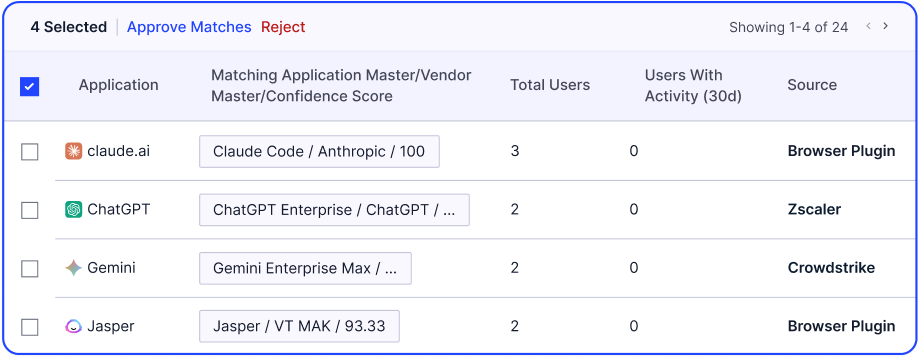
How it helps:
- Surfaces apps bought on corporate cards or signed up with work email.
- Detects AI tools through browser, Zscaler and CrowdStrike signals.
- Adds each newly discovered app to the scope you govern and review.
Your SOC 2 scope matches what employees actually use.
4. Privileged Access Visibility
Excess admin rights are one of the most common SOC 2 exceptions. CloudEagle.ai continuously monitors privileged access across every SaaS app and flags permissions that no longer match a user's role.
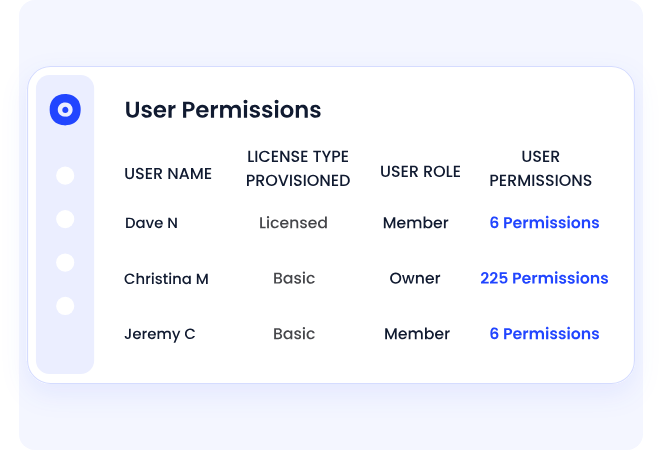
How it helps:
- Spots orphaned identities and over-provisioned users in every app.
- Flags access that outlasted a move, promotion or departure.
- Revokes excess access without waiting for the next audit cycle.
Least privilege holds between audits, not only during them.
See how Lob brought privileged user access under centralized governance with CloudEagle.ai.
5. SaaS Security Posture Management
CloudEagle.ai tracks the security posture of every SaaS app in one continuously updated dashboard, including MFA and SSO enforcement, security configuration and alignment with frameworks like NIST 800. It pulls enforcement signals from Okta and Entra, adds a risk score from Netskope's Cloud Confidence Index, and accepts manual entry for anything it cannot pull.
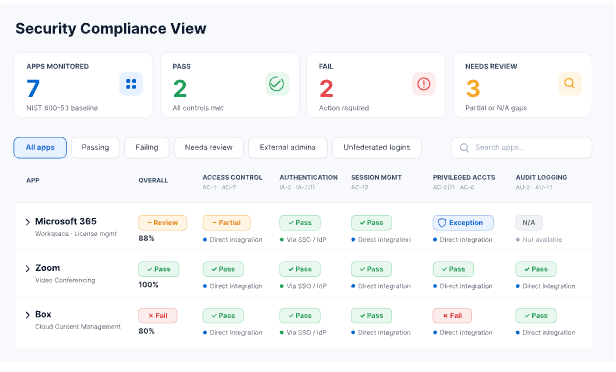
How it helps:
- Shows pass or fail status per posture check, per app.
- Replaces app-by-app MFA and SSO checks with one live view.
- Tracks NIST 800 alignment alongside your SOC 2 work.
Posture evidence is current on audit day, not rebuilt the week before.
6. Non-Human Identity Governance
Service accounts, API keys, and AI agents touch the same customer data your SOC 2 controls protect, yet most access reviews only cover employees. CloudEagle.ai governs non-human identities with the same lifecycle controls, access reviews and least-privilege checks as human users.
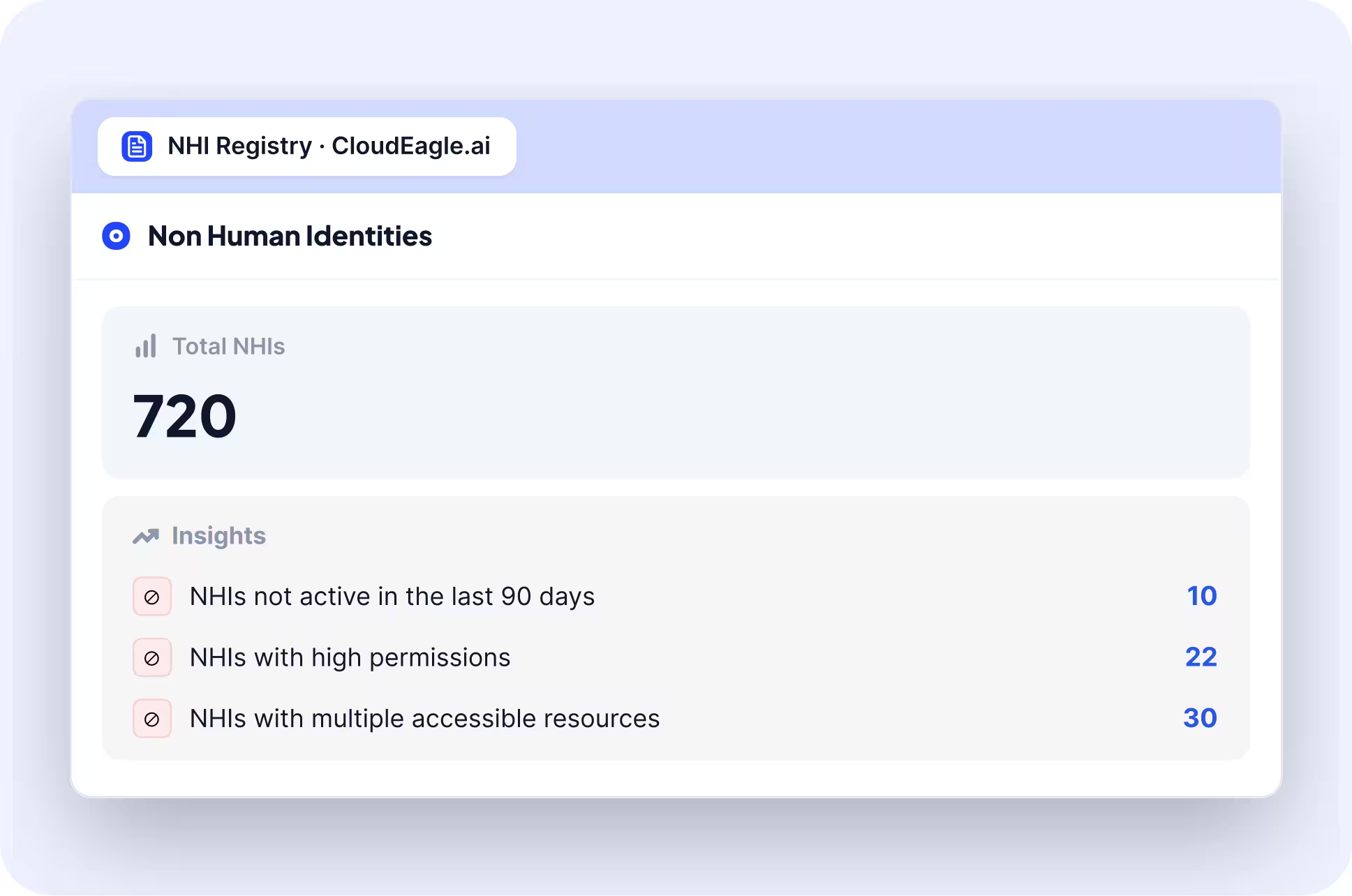
How it helps:
- Discovers AI agents and MCP servers alongside SaaS apps.
- Gives every machine identity an owner and a review cycle.
- Extends access reviews and least privilege to machine identities.
Your access evidence covers people and machines in one record.
Pros
- Covers SaaS apps, AI tools and non-human identities in one platform, so your SOC 2 scope stays complete.
- Ensures the right people have the right access, reducing the risk of unauthorized access to sensitive data.
- Captures audit evidence continuously instead of in the weeks before an audit.
- Connects to your stack through 500+ direct integrations, with onboarding in about 30 minutes.
- Runs reviews and approvals in Slack, so reviewers act without opening another tool.
Pricing: Book a demo to request a quote.
SOC 2 Compliance Doesn't Wait For You


2. Vanta
Vanta is a SOC 2 Type 2 compliance platform that automates the process of meeting SOC 2 Type 2 standards. It helps businesses monitor security, collect evidence, and generate audit-ready reports with minimal manual work. Vanta integrates with your existing systems, making it easy to stay compliant without hassle.
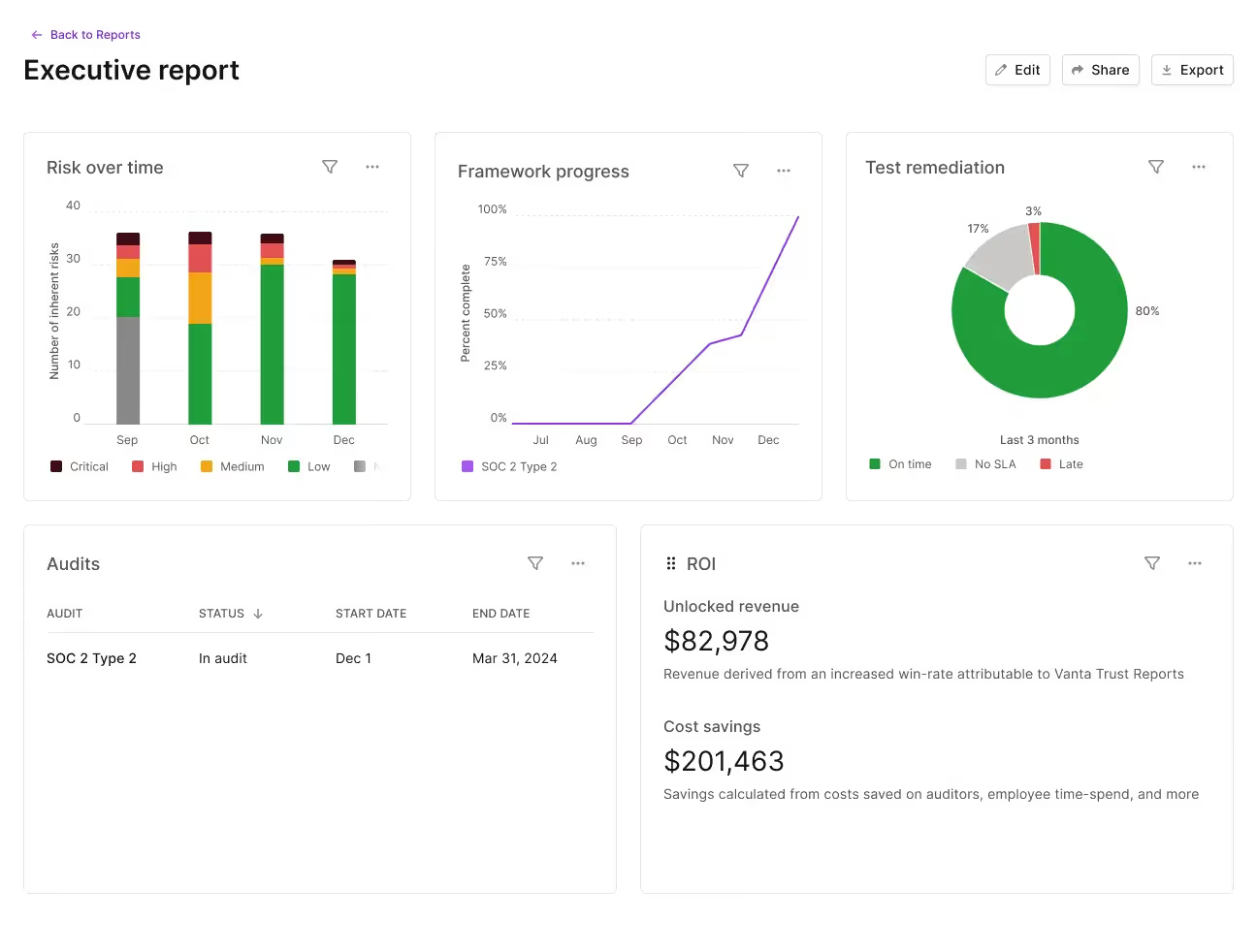
Key Features
- Continuously tracks your systems to ensure you meet SOC 2 Type 2 security and privacy standards.
- Generates audit-ready reports that are easy to submit to auditors without manual effort.
Pros
- Quick and easy setup with a user-friendly interface.
- Simplifies the audit process with pre-built templates and ready-to-submit reports.
Cons
- Limited customization options for complex, unique workflows.
- Some features may require third-party integrations for full functionality.
3. Drata
Drata simplifies SOC 2 Type 2 compliance by continuously monitoring your systems and automatically collecting the necessary audit evidence. It integrates easily with your tech stack, providing real-time compliance tracking and automated reporting, so your organization remains compliant year-round.
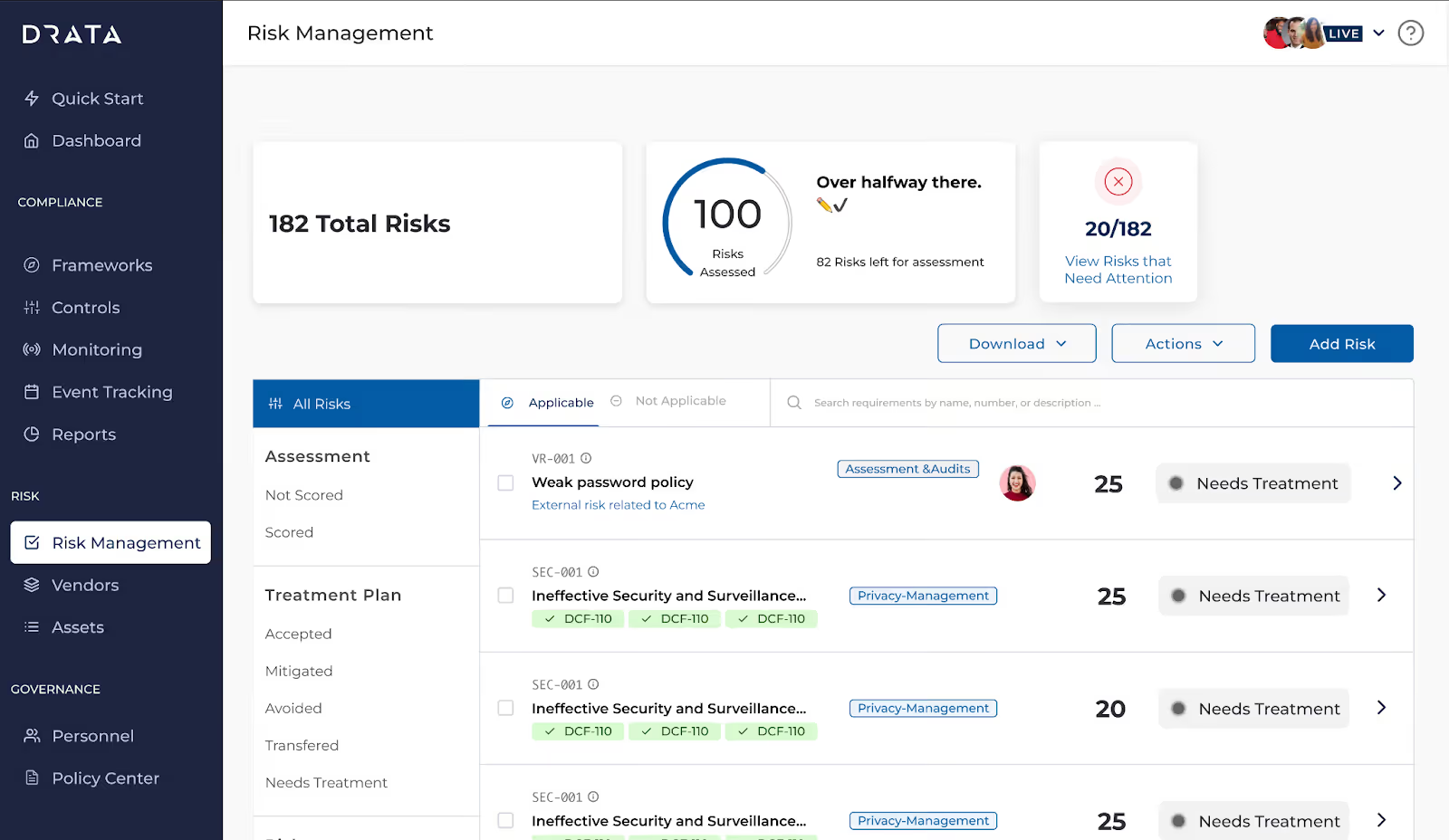
Key Features
- Tracks your systems and security measures in real time to ensure they meet SOC 2 Type 2 standards.
- Automatically collects the evidence needed for audits, reducing manual work.
Pros
- Automates the evidence collection process, saving time during audits.
- Offers a variety of integrations with popular platforms like Slack, AWS, and Google Cloud.
Cons
- Pricing may be a concern for smaller businesses.
- The platform may not cover every niche compliance need for all industries.
4. Sprinto
Sprinto is a SOC 2 Type 2 compliance platform that automates security monitoring, evidence collection, and audit preparation. It helps businesses track their compliance progress in real time, ensuring they always meet SOC 2 Type 2 requirements without the need for manual work.
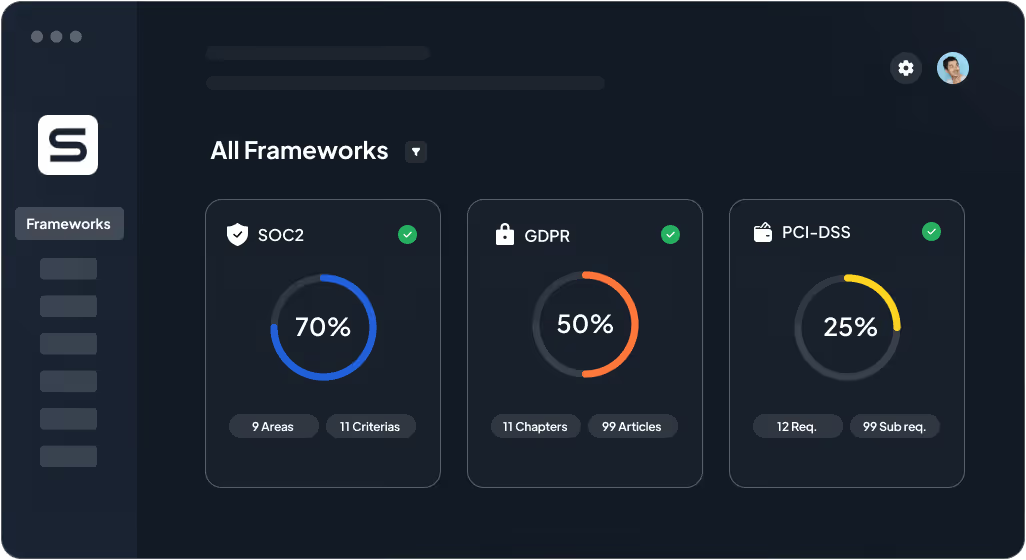
Key Features
- Automates the majority of compliance tasks, reducing the manual effort required.
- Prepares ready-to-submit reports for SOC 2 Type 2 audits.
Pros
- Fast implementation and user-friendly interface.
- Integrates with various platforms for seamless workflow management.
Cons
- Limited customization for complex, non-standard requirements.
- It can become costly as your organization grows.
Related Article: SOC 2 Audit Checklist To Stay Audit-Ready in 2026
5. Secureframe
Secureframe helps businesses automate their SOC 2 Type 2 compliance processes, from monitoring security to generating audit reports. The platform integrates with your existing systems to ensure continuous compliance, reducing manual effort and making audits more efficient.

Key Features
- Tracks your systems and data to ensure compliance with SOC 2 Type 2 requirements.
- Generates compliance reports that are easy to submit during audits.
Pros
- Simple user interface that reduces the learning curve.
- Comprehensive compliance management with easy-to-use features.
Cons
- The platform may not cover every security compliance requirement for all industries.
- Pricing might be prohibitive for small organizations.
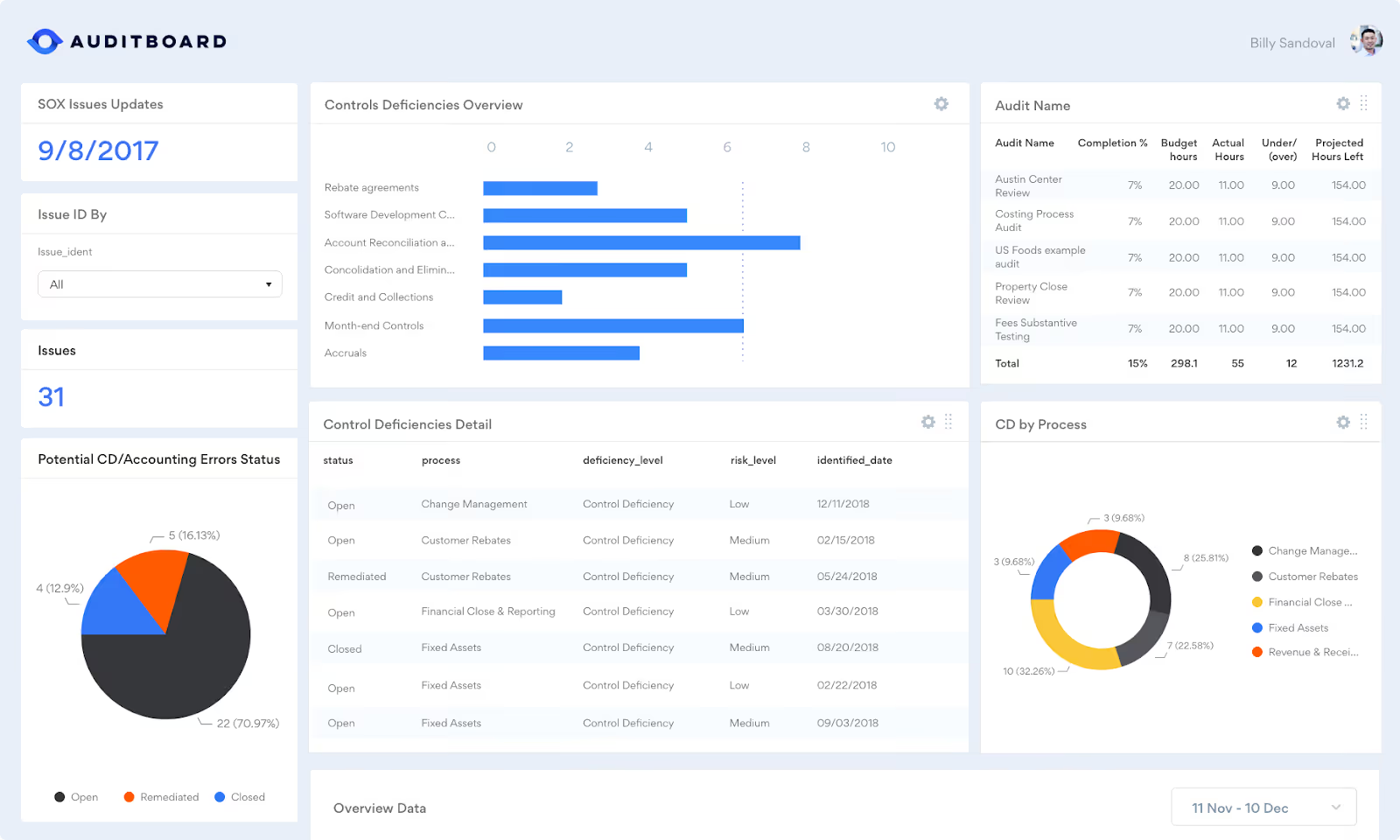
6. AuditBoard
AuditBoard simplifies SOC 2 Type 2 compliance by automating compliance tracking, audit tasks, and evidence collection. It provides real-time insights and powerful reporting features, making it easier for organizations to stay compliant with SOC 2 Type 2 throughout the year.
Key Features
- Tracks your compliance progress continuously and flags any issues.
- Simplifies the audit process by providing the tools to manage audits and compliance reviews.
Pros
- Streamlined auditing process with easy-to-navigate tools.
- Provides real-time insights into your compliance status.
Cons
- Requires time to integrate with existing workflows fully.
- Some advanced features require additional configuration.
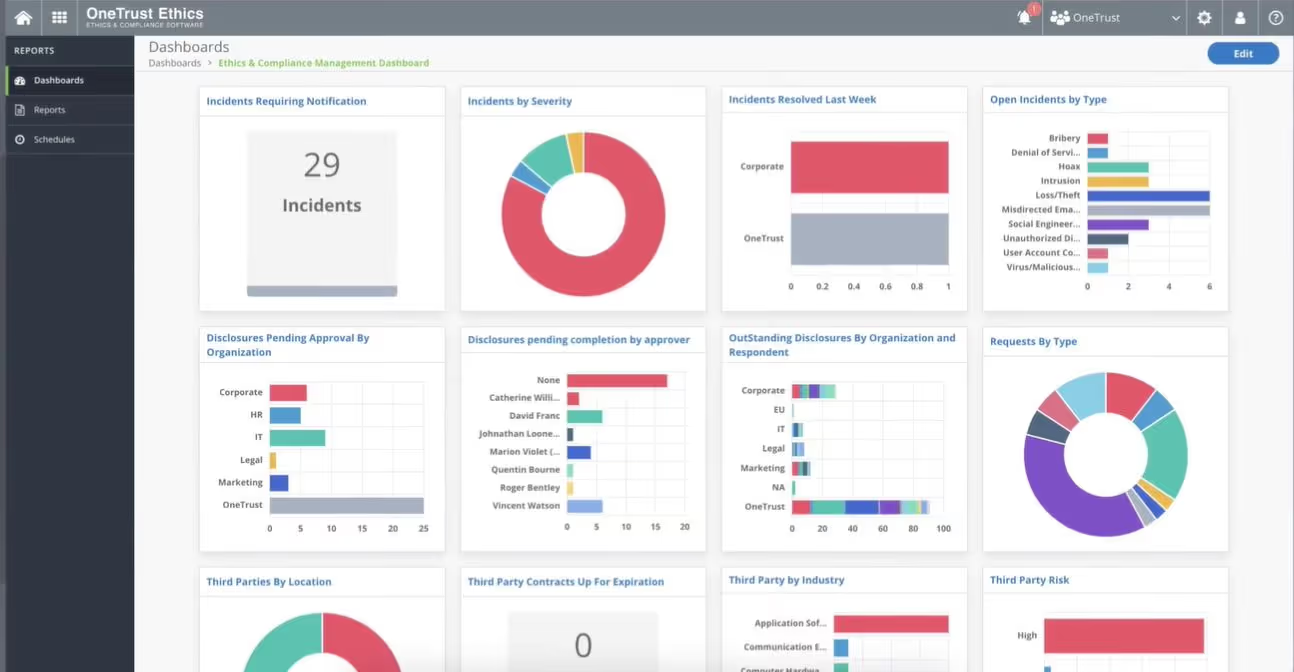
7. OneTrust
OneTrust is a comprehensive platform that automates SOC 2 Type 2 compliance, including privacy and security tasks. With customizable workflows and real-time monitoring, OneTrust helps businesses maintain compliance while reducing manual effort and ensuring security.
Key Features
- Automates privacy and security tasks, including SOC 2 Type 2 compliance.
- Allows businesses to tailor compliance workflows to meet their specific needs.
Pros
- Highly customizable to fit various industry needs.
- Comprehensive dashboard for easy tracking of compliance activities.
Cons
- High pricing, especially for smaller businesses.
- Some features require additional configuration and setup.
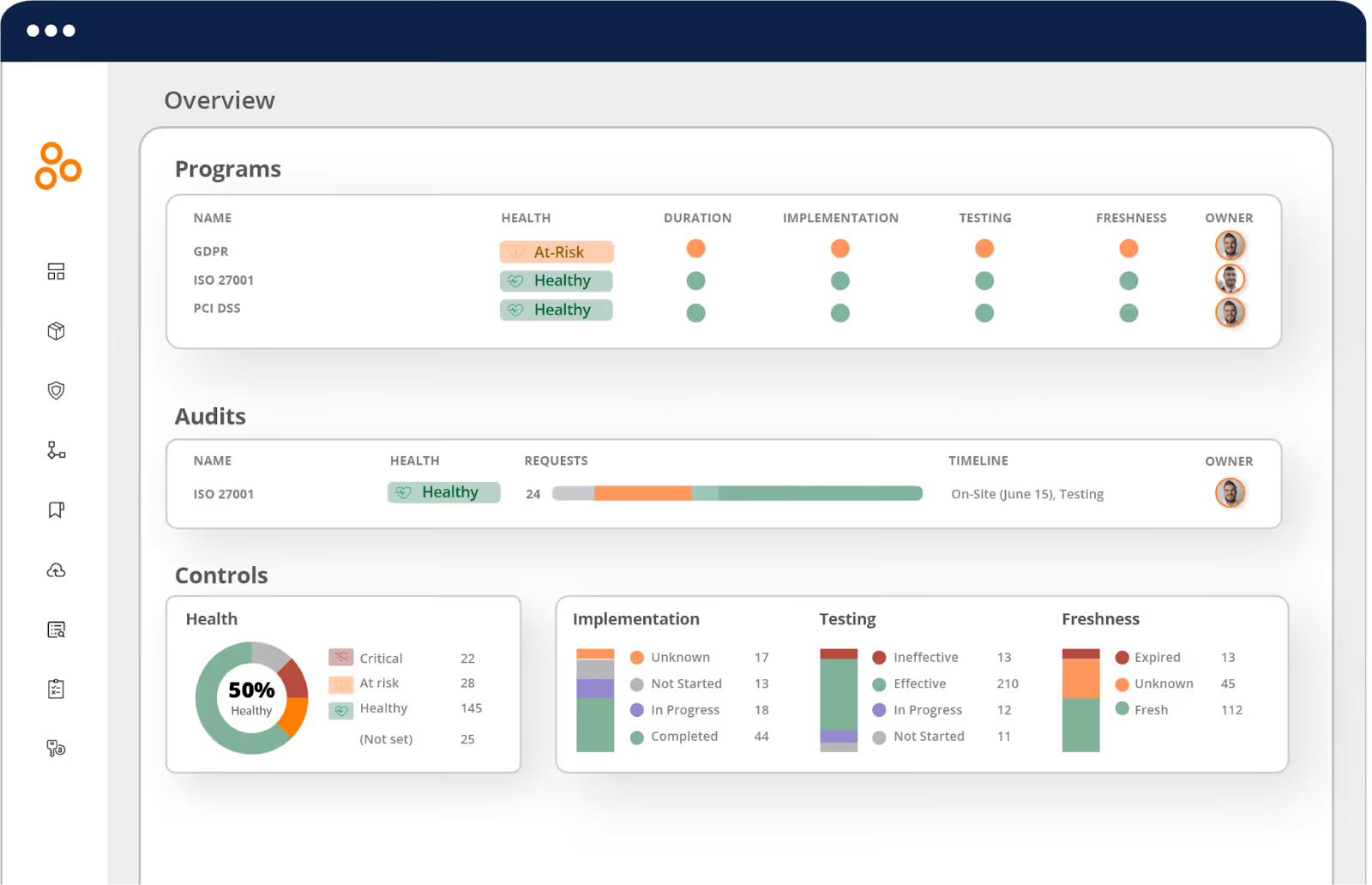
8. Hyperproof
Hyperproof is a SOC 2 Type 2 compliance platform that automates compliance management and streamlines workflows. It helps businesses monitor security controls, generate audit reports, and track progress in real time, ensuring consistent adherence to SOC 2 Type 2 standards.
Key Features
- Automates key compliance tasks, ensuring continuous adherence to SOC 2 Type 2 standards.
- Tracks your compliance progress in real time, allowing you to address issues immediately.
Pros
- Reduces manual compliance tasks through automation.
- Easy-to-use interface for better team collaboration.
Cons
- Some advanced features may require additional configuration.
- Limited integrations with some non-standard tools.
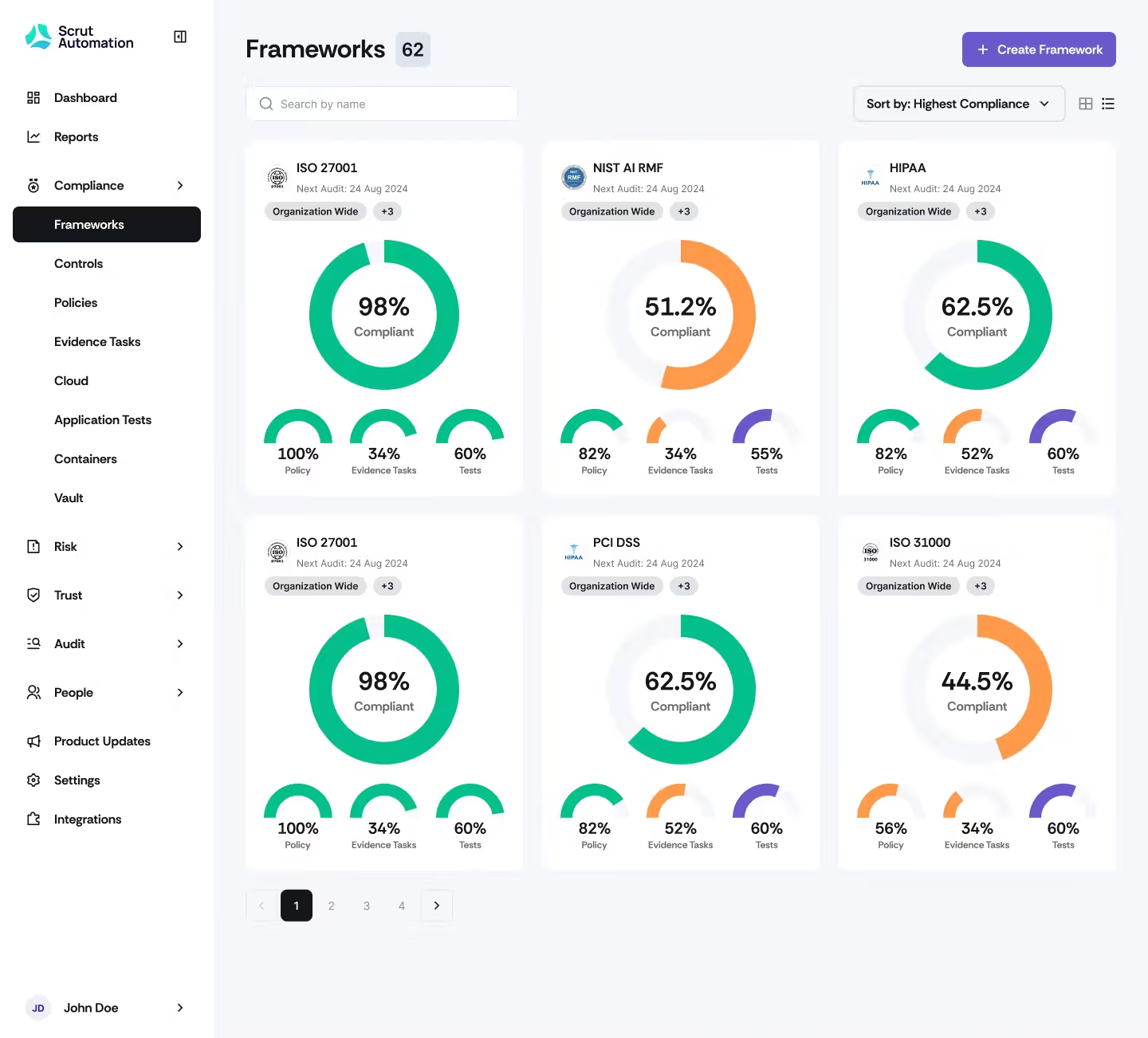
9. Scrut Automation
Scrut Automation simplifies SOC 2 Type 2 compliance with automated security monitoring, evidence collection, and reporting. It integrates with your existing tools, continuously tracks compliance, and makes it easy to stay audit-ready year-round with minimal effort.
Key Features
- Keeps an eye on your systems 24/7 to ensure they meet SOC 2 Type 2 requirements.
- Seamlessly integrates with your current tech stack for a smooth compliance experience.
Pros
- Simplifies the compliance process with automated features.
- Offers real-time tracking and alerts.
Cons
- It can require setup time to integrate fully with existing systems.
- Some users may find the interface complex at first.
10. Apptega
Apptega is a SOC 2 Type 2 compliance platform that centralizes all your compliance activities. It helps businesses automate workflows, track compliance progress, and generate audit-ready reports, making the process of staying compliant faster and more efficient.
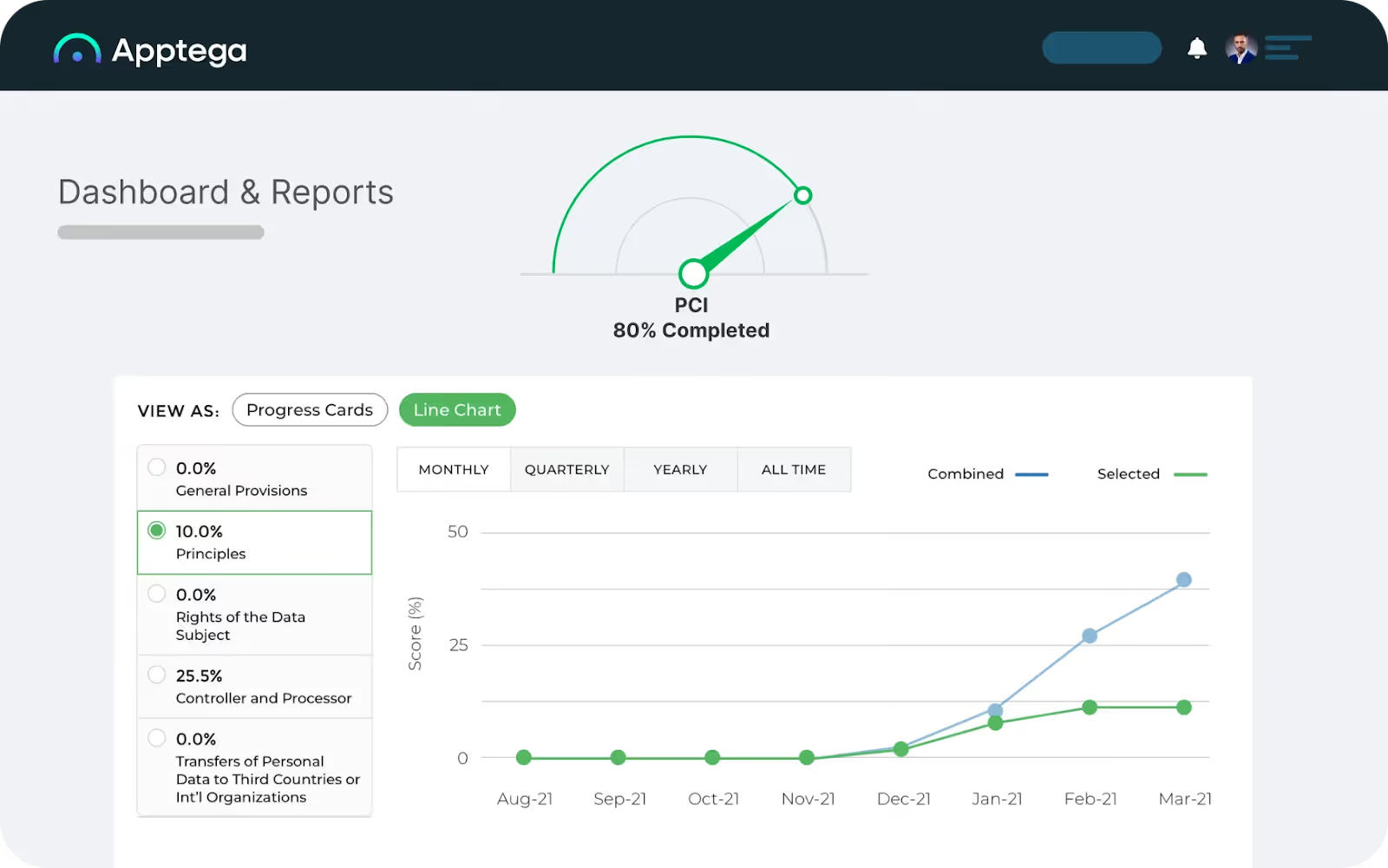
Key Features
- All compliance activities are managed from a single platform for ease of use.
- Reduces manual intervention by automating compliance tasks and audit preparation.
Pros
- Streamlines compliance management with automated workflows.
- Provides easy access to all compliance data in one place.
Cons
- May require time to fully integrate with certain business systems.
- Limited customization for specific industry needs.
Quick Comparison: Top SOC 2 Compliance Software For SOC 2 Readiness
The table below maps each platform across the dimensions that matter most to compliance, security, and IT teams. Use it to shortlist candidates before reviewing individual profiles.
SOC 2 Compliance Software vs SOC 2 Audit Firms: Which Do You Need?
You need both to get a SOC 2 Type 2 report, because they do different jobs. A SOC 2 compliance tool keeps controls running and evidence current across the review period. An independent CPA firm then tests those controls and signs the opinion your customers read.
A third group, SOC 2 compliance services and cloud consulting firms, sits in between. They run readiness assessments, write policies and close gaps before the audit window opens. Most companies keep that readiness partner separate from the firm that performs the audit, so the auditor stays independent of the controls it tests.
The same audit firms usually offer all three SOC reports. SOC 1 covers controls that affect a client's financial reporting and often feeds SOX audits. SOC 2 covers the five Trust Services Criteria and is shared under NDA. SOC 3 is a short public summary of a SOC 2 report.
How to Choose a SOC 2 Auditor
The best SOC 2 auditor for your company is a licensed CPA firm that understands your stack, prices the scope up front and can work inside the compliance software you already run. Use these checks to shortlist SOC 2 audit firms.
1. License and peer review: Only licensed CPA firms can issue a SOC 2 report. Ask for the firm's most recent AICPA peer review letter before you sign.
2. Security depth on the fieldwork team: The partner who signs the opinion is rarely the person testing your controls. Ask who performs fieldwork and what cloud and identity experience they bring.
3. Platform fluency: Vanta and Drata both run auditor partner networks. An auditor already working in your platform can pull evidence directly instead of asking for exports.
4. Fixed scope and fee: Agree on the Trust Services Criteria in scope, the review window and the cost of scope changes before fieldwork starts.
5. Recognition with your buyers: Enterprise customers sometimes prefer established names. Firms such as Schellman perform SOC 1, SOC 2 and SOC 3 examinations, and smaller specialist firms often move faster for first-time reports.
Whichever firm you pick will sample access reviews and deprovisioning records for every in-scope app. It helps to know what auditors check in a user access review before the window opens, because that evidence is where SaaS-heavy companies lose the most time.
Why Use a SOC 2 Compliance Software? Why Not Do it Manual?
A SOC 2 compliance platform makes it easier for businesses to stay on top of SOC 2 Type 2 compliance and maintain the necessary security and privacy standards. Enterprises are shifting from manual, spreadsheet-driven SOC 2 audits to automated, continuous compliance platforms.
Here’s why using one can benefit your organization:
1. Streamlines Compliance: These platforms automate key tasks like tracking user access, monitoring security measures, and generating reports. This helps you stay compliant without spending too much time on manual work, making the whole process more efficient.
2. Real-Time Monitoring: A SOC 2 compliance software continuously monitors your systems for any suspicious activities or potential security issues. It sends instant alerts if something unusual happens, allowing your team to quickly take action before problems get bigger.
3. Simplifies Audits: When it’s time for a SOC 2 audit, these platforms make things much easier by automatically creating audit-ready reports. This reduces the stress of preparing for audits and ensures you meet all the necessary compliance requirements without hassle.
4. Improves Security: By tracking your security practices and monitoring who accesses your data, SOC 2 compliance platforms help prevent data breaches or unauthorized access. They help you maintain strong security protocols that protect your organization and your customers.
To ensure continuous compliance with best practices, align your platform's controls with a comprehensive framework of SaaS security best practices and controls.
“Compliance is not security. But security must always be compliant,” Shamla Naidoo, Head of Cloud Strategy, Netskope.
5. Cost-Effective: While a SOC 2 compliance platform may have an upfront cost, it can actually save you money in the long run by reducing the time and effort spent on compliance tasks. Plus, it helps you avoid costly fines for non-compliance.
A Quick Overview of a Typical SOC 2 Compliance Software - With Checklist
SOC 2 compliance software automates security control monitoring and evidence collection. Instead of static dashboards, these platforms map controls to the AICPA Trust Services Criteria and identify failures in real time to ensure year-round audit readiness.
A complete SOC 2 platform eliminates manual spreadsheet workarounds by providing:
- Control mapping to all five Trust Services Criteria (Security, Availability, Processing Integrity, Confidentiality, and Privacy)
- Automated evidence collection from connected systems to eliminate manual screenshots
- Continuous monitoring to detect control drift between audit cycles
- Audit-ready reporting generated on demand
- Access review workflows with automated deprovisioning proof
- Vendor risk tracking to manage third-party security gaps
The right SOC 2 compliance software integrates with your existing tools, such as Okta, Jira, and Coupa, to create a unified system of record for audit-proof and operational governance.
How to Check If a Vendor Is SOC 2 Compliant
To confirm a vendor is SOC 2 compliant, ask for its latest SOC 2 Type 2 report and read five things before you sign. Teams shortlisting SOC 2 compliant HRIS platforms, payment platforms or booking software run the same check, only the criteria that matter most change by category.
1. Report type and date: Look for a Type 2 report whose review period ended within the last 12 months. If there is a gap between the period end and today, ask for a bridge letter.
2. Scope: Confirm the system described in the report covers the product you are buying, not only the vendor's corporate IT.
3. Trust Services Criteria: Security is always included. Check that the other criteria match how you will use the product.
4. Exceptions: Read the auditor's test results. An exception is not automatically a dealbreaker, but the vendor should explain how it was fixed.
5. Complementary user entity controls: These are the controls the vendor expects you to run on your side, such as SSO enforcement or access reviews. If you skip them, the vendor's report does not fully cover you.
This check only works for vendors IT knows about. An HRIS add-on or AI note-taker bought on a corporate card never reaches security review, so its SOC 2 report is never read. Finding the SaaS and AI tools nobody routed through procurement is the step that puts every vendor through the same review.
How to Choose the Right SOC 2 Type 2 Software?
Choosing the right SOC 2 Type 2 compliance platform is essential for streamlining your process and ensuring strong security. SOC 2 Type 2 requires consistent monitoring over 6-12 months, which is why clients and vendors prefer it for proving ongoing security.
Bernard Gallagher, Principal, I.S. Partners, LLC, believes:
"The most important requirement of SOC 2 is that businesses need to develop security policies and procedures that are written out and followed by everyone [within their organization]. These policies and procedures serve as guides for auditors who will review them."
Here are key factors to consider when selecting a platform for your business:
1. Ease of Use and Implementation
The platform should be user-friendly and easy to implement. Look for tools with quick onboarding processes, such as Vanta or Drata, that offer simple setup and clear step-by-step guidance. This will save time and minimize the learning curve for your team.
2. Integration Capabilities
The platform should seamlessly integrate with your existing systems, such as HR, cloud services, and security tools. Ensure that the platform can connect with the tools you're already using, like AWS, Google Cloud, or Slack. The more integrations it offers, the smoother your compliance process will be.
3. Reporting and Audit-Readiness
Ensure that the platform offers built-in audit tools and generates ready-to-submit reports for SOC 2 Type 2 audits. This will streamline the audit process, saving your team time and making the audit much easier to manage.
4. Security Features
Security is a top priority for any SOC 2 Type 2 compliance platform. Ensure the platform provides strong security controls, including access management, data encryption, and continuous security monitoring, to protect your organization's sensitive data.
Additionally, enterprises should ensure their broader network aligns with established enterprise network security tools and practices.
5. Scalability
Consider the platform's ability to scale with your business as it grows. A good SOC 2 Type 2 compliance platform should be flexible and scalable, accommodating your organization's changing needs over time. This will help you maintain compliance as you expand your operations and add new systems or applications.
6. Pricing
Finally, compare the pricing of different SOC 2 Type 2 compliance platforms to ensure it fits within your budget. Some platforms charge a monthly or annual fee, while others may have tiered pricing depending on the features and services you need.
7. Coverage of AI Tools and Non-Human Identities
Check whether the SOC 2 compliance software sees AI tools and machine identities or only employee accounts. Evidence built on an inventory that misses AI apps and service accounts leaves your auditor asking about systems nobody reviewed.
Conclusion
Maintaining SOC 2 Type 2 compliance is essential for businesses handling sensitive data. Using a SOC 2 Type 2 compliance platform makes this process much easier. Organizations that conduct SOC 2 readiness assessments see a 30% improvement in audit success rates.
By using a SOC 2 Type 2 compliance platform, businesses can strengthen security, stay audit-ready, and build trust with customers. The right platform makes SOC 2 Type 2 compliance simpler, more secure, and scalable.
These tools offer features such as real-time monitoring, automated workflows, and audit-ready documentation, reducing manual effort and minimizing compliance risks. However, it’s important to consider your organization’s specific needs, pricing, and integration capabilities before choosing the right platform.
For companies also managing broader IT governance audits, understanding IT controls and governance audit requirements is equally essential for comprehensive compliance.
Schedule a demo with CloudEagle.ai to streamline your compliance efforts.
FAQs
1. Who issues SOC 2 Type 2?
SOC 2 Type 2 reports are issued by Certified Public Accountants (CPAs) or independent audit firms after evaluating your organization's controls over a specific period (usually 6-12 months).
2. Is SOC 2 the same as ISO 27001?
No, SOC 2 focuses on security, availability, confidentiality, and privacy of data, while ISO 27001 is a broader framework that provides requirements for an information security management system (ISMS). SOC 2 is more specific to service organizations, while ISO 27001 applies to a wider range of organizations.
3. Is SOC 2 legally required?
SOC 2 compliance is not legally required for most businesses but is often required by clients, particularly in industries like SaaS, finance, and healthcare, as part of contracts or to demonstrate trustworthiness in handling sensitive data.
4. How long is a SOC 2 Type 2 audit?
A SOC 2 Type 2 audit typically lasts between 6 to 12 months, depending on the scope of the audit and the organization's operations. The audit period covers the entire duration of the controls being evaluated.
5. What is the difference between HIPAA and SOC 2 compliance?
HIPAA (Health Insurance Portability and Accountability Act) is focused on the protection of healthcare data, while SOC 2 is more general and focuses on the security and privacy of data for any service provider. SOC 2 applies to a broader range of industries, while HIPAA specifically governs healthcare-related entities.
6. We already have a SOC 2 auditor. Do we still need SOC 2 compliance software?
Your auditor tests evidence; it does not collect it for you. Without software, your team pulls access reviews, deprovisioning records and control screenshots by hand across every in-scope app for the full review period. That manual collection is where most Type 2 controls slip.
7. Is a SOC 2 Type 1 report enough, or will buyers ask for Type 2?
A SOC 2 Type 1 report confirms your controls were designed correctly on a single date. It works as a first step, but most enterprise buyers ask for Type 2 because it shows those controls kept working over 6-12 months.
SOC 2 Compliance Doesn't Wait For You


.avif)


.avif)
.avif)




.png)







.avif)
.avif)
.avif)


