







Your Exposure Score
—/100
—
—
—
Risk Dimension Breakdown
Data Leakage
—
—
Governance
—
—
Compliance
—
—
Executive Summary
—
What this means for your organisation
—

Imagine: Someone on your team just started using a new AI tool. It wasn't approved, nobody reviewed it, and it has access to sensitive company data. Meanwhile, AI features are quietly activating inside tools you already pay for, and nobody knows they're on.
Employees are adopting AI faster than security can track. Answer 10 questions to uncover your exposure score.
Takes 4 minutes · No signup to start
Your Exposure Score
—
—
Risk Dimension Breakdown
Data Leakage
—
—
Governance
—
—
Compliance
—
—
Executive Summary
—
What this means for your organisation
—
Identified Risk Areas
The areas below scored 1 or 2 in your assessment. Each represents a specific maturity gap with a clear first action.
Closing the Gaps
CloudEagle is the AI-powered control plane for SaaS, identity, and AI governance — trusted by enterprises like RingCentral, Automation Anywhere, Shiji, and Rec Room. The platform has processed $20B+ in spend, delivered $2B+ in customer savings, and connects via 500+ direct integrations. The exposures identified in this report sit directly within what CloudEagle was built to govern.
Discover Every AI Tool, Sanctioned or Shadow
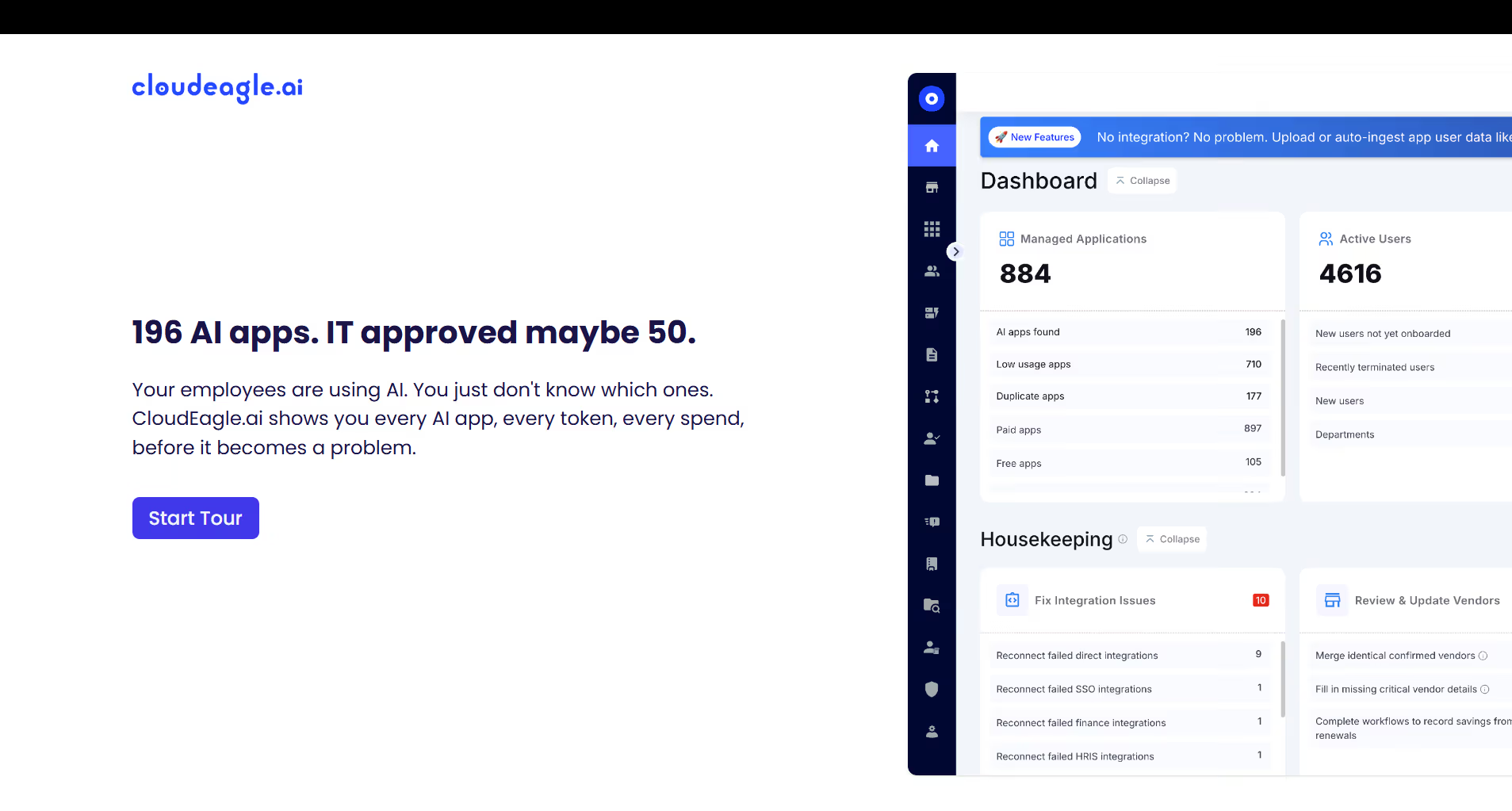
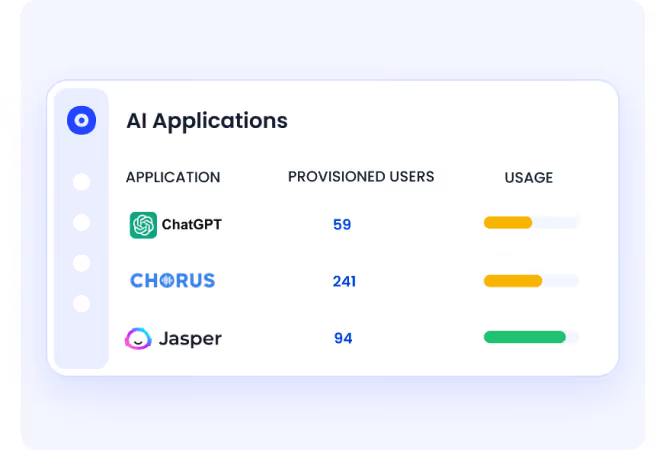
Most organisations discover Shadow AI after an incident. CloudEagle maintains a real-time inventory of every AI tool in use by correlating SSO, browser extension, firewall, and finance data against a proprietary AI application catalog (the SaaSMap). Discovery is continuous rather than periodic — when a new AI tool is adopted, you know within hours, not at the next quarterly audit.
Enforce AI Governance, Don't Just Document It
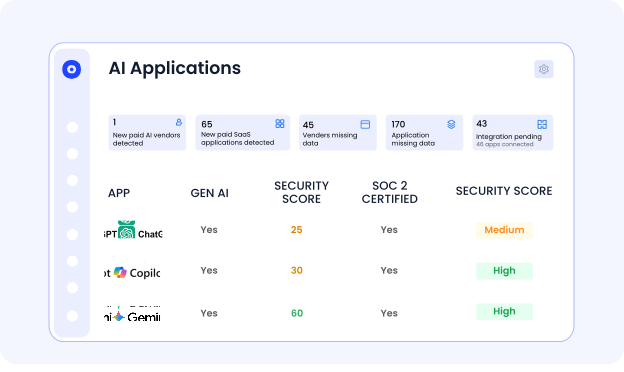
A policy that exists only on paper is not a control. CloudEagle enforces your AI acceptable use policy technically — monitoring what data enters AI tools, blocking sensitive content from reaching unmanaged applications, and presenting flash pages that redirect users to approved alternatives. PII detection, approval workflows, and a complete audit trail are built in, producing the kind of defensible governance regulators and boards now require.
Govern the Full AI Lifecycle, Not Just the Login
AI tools carry the same lifecycle risks as any SaaS application — plus a few unique ones (non-human identities, API tokens, usage-based billing). CloudEagle brings AI into the same control plane as your broader SaaS estate: spend tracking, license right-sizing, access reviews, compliance scope, and automated offboarding. When an employee leaves, their AI access — including tokens and personal-account logins — is revoked alongside everything else.
Book a Shadow AI Audit
In a focused 30-minute session, a CloudEagle specialist maps your specific exposure against our governance framework and shows what defensible AI governance looks like for your environment. No generic demo, no obligation.
cloudeagle.ai/book-a-demo

LLM gateways, CASBs, and DLP tools each cover a different surface. None of them cover prompt-layer enforcement and AI spend attribution at the same time.
❌ Misses 60–70% of shadow AI use
❌ No prompt-level enforcement
❌ Acts after data is already submitted
❌ No prompt-level enforcement
❌ Hard block, no visibility
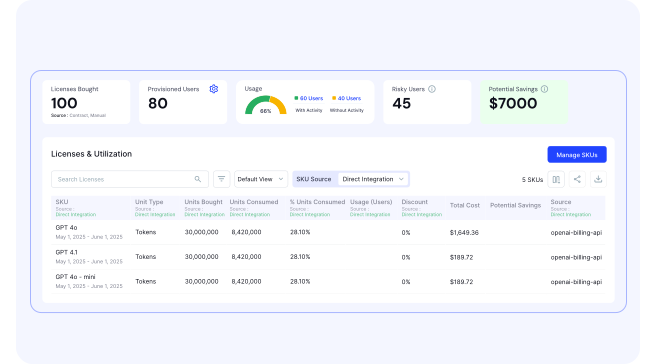

No. Token consumption for Claude, ChatGPT, Cursor, and Gemini is tracked via direct API, no browser plugin or endpoint agent required. The browser extension is a separate, optional deployment used for shadow AI discovery and prompt-layer enforcement on unapproved tools.
Anthropic shows total consumption and billing. CloudEagle adds per-user attribution, model-level breakdown (Opus vs Sonnet vs Haiku), department and team cost allocation, threshold alerts, dormant user identification, and 90-day consumption trends, the data Finance and Procurement actually need.
The default is a soft redirect, a flash page that shows the approved alternative and lets the employee request an exception. Hard blocking via Palo Alto integration is available but optional. Most customers start with soft enforcement because hard blocks create workarounds within 48 hours.
CASBs operate at the network layer, they can't intercept at the prompt or track token-level spend. LLM gateways cover API-connected usage only and miss browser-based AI access entirely. CloudEagle closes both gaps and adds spend attribution and AI lifecycle governance that neither covers.
Average onboarding is 30 minutes. Connect your SSO, finance system, and optionally a CASB or firewall source. Most customers see their complete AI inventory within the first session.
Yes. CloudEagle integrates with and complements your existing stack. It ingests signals from Zscaler and CrowdStrike for discovery, and can operate alongside policy enforcement tools while you evaluate consolidation. It doesn't require replacing anything to get started.
The CISO focuses on risk exposure, which AI tools are accessing sensitive data, vendor risk profiles, and whether enforcement is in place. The CAIO focuses on governance and adoption, which models are being used, at what cost, whether usage aligns with business value, and whether the AI program has an audit trail for regulators. CloudEagle gives both views from the same platform.
Yes. CloudEagle's Universal Connector ingests usage data via S3, a script extracts the tool's admin export on a schedule and CloudEagle correlates it automatically.
It requires four things: a real-time inventory of every AI tool in use, documented access controls, evidence that policy is enforced technically (not just on paper), and vendor risk scores. CloudEagle produces all four continuously, not assembled manually when an auditor asks.
As soon as AI tools appear in the environment. One customer found 10,000 ChatGPT installs they had never approved — most organizations discover this after an incident. The earlier governance starts, the less retroactive cleanup is required.