You need to enable JavaScript in order to use the AI chatbot tool powered by ChatBot

How to Govern Google Gemini Pricing Across Your Enterprise

Share via:
blog-cms-banner-bg
Little-Known Negotiation Hacks to Get the Best Deal on Slack
cta-bg-blogDownload Your Copy

HIPAA Compliance Checklist for 2025

Download PDF

TL;DR

  • At enterprise scale, Google Gemini pricing is a governance problem, not a plan-selection problem. The plan price is the easy part.
  • The spend that hurts is unused seats, unwatched API tokens, and Gemini access nobody approved.
  • List price and what companies actually pay are different numbers. CloudEagle.ai benchmark data shows the levers that bring the rate down.
  • The fix is one view across licenses, token consumption, and shadow access, refreshed continuously instead of at renewal.
  • CloudEagle.ai is how enterprises get all three under control before the bill arrives.

At enterprise scale the question stops being which Gemini plan to buy. It becomes how to govern the spend once Gemini is already everywhere. The plan price is the smallest and most predictable line on your bill. 

What grows underneath it is harder to see: the licenses sitting idle and the API usage nobody can trace back to a team. That gap is the real story of Google Gemini pricing at scale, and this guide is about getting it under control.

Stop Overpaying for AI Tools

AI tools inflate spend fast. Control it.
Download Guide

Why Gemini Pricing Gets Harder to Control at Scale

The trouble with Gemini cost is not that any one number is high. It is that there are so many meters, and most of them run without anyone deciding to turn them on.

The Consumer Tiers Already Running Inside Your Org

The consumer side of Google Gemini pricing shows up inside your company whether you bought it or not. 

Google sells Gemini to individuals through Google One, and after Google reset the consumer plans at I/O 2026, the lineup tiers by usage limits and feature access, all running on Gemini 3.

  • Google AI Plus around $4.99 a month, with 400 GB of storage after a mid-2026 price cut. The entry paid tier for light personal use.
  • Google AI Pro around $19.99 a month. The mainstream paid plan, with higher limits and access to Deep Research.
  • Google AI Ultra from $99.99 a month, with a $200 top tier. Google cut both from $249.99 and $250 at I/O 2026. The highest limits and the most advanced models.

Employees expense these on personal cards or sign up with a work email, and the spend never touches a procurement workflow.

Gemini Pricing Gets Complicated Faster Than Most Teams Expect

Explore how usage tiers, enterprise access, and AI adoption patterns can quietly increase Gemini spend over time.
See Buyer Guide

Workspace Business and Enterprise Add Their Own Meters

Google has folded Gemini directly into Google Workspace, so the AI now rides inside Gmail, Docs, Sheets, and Meet rather than sitting beside them as a separate add-on.

The standalone Gemini add-on that used to cost $20 to $30 per user is gone. 

Google retired it in 2025 and raised the base plan prices instead, so Gemini now comes bundled into every paid tier. Current per-user pricing on annual billing:

  • Business Starter around $8 per user per month, with limited Gemini.
  • Business Standard around $14 per user per month.
  • Business Plus around $22 per user per month.
  • Enterprise custom-quoted, roughly $36 per user per month for Enterprise Plus per recent benchmark deal data.

The catch is that a Workspace seat assigns Gemini to a person whether or not that person ever opens it, so the meter runs on headcount, not adoption.

Where API and Token Pricing Turns Unpredictable

For anything built in-house, Gemini API pricing bills per token, and the rate depends on which model a developer points at. 

Output tokens cost several times more than input tokens, so verbose prompt design quietly multiplies the bill. 

Approximate current rates per one million tokens:

Model Input Output Best for
Gemini 3.1 Pro ~$2 ~$12 Flagship reasoning, large-context work
Gemini 3.5 Flash ~$1.50 ~$9 Everyday, balanced speed and cost
Gemini 3.1 Flash-Lite ~$0.25 ~$1.50 High-volume, cost-sensitive pipelines
Rates are per 1M tokens, from Google's Gemini API pricing. Gemini 3.1 Pro pricing roughly doubles above 200K tokens of context.

On top of the base rate sit context caching fees, grounding with Google Search priced as a separate meter, and image or audio generation billed on their own. 

One wrinkle worth catching early: Gemini 2.0 Flash was shut down on June 1, 2026, so any pipeline still pointed at it has already broken or migrated. 

Batch processing runs at roughly half price for work that is not time-sensitive.

Why You Pay for the Lineup You Bought Not the Usage You Got

Put those three tracks together and the pattern is clear. You are billed for the plans and seats and model access you provisioned, not for the usage you actually got. 

The gap between the two is where enterprise Gemini spend leaks, and no pricing page will show it to you because the pricing page only knows list price.

SaaS and AI Spend Calculator

CloudEagle.ai customers typically recover 10–30% of annual SaaS and AI spend. Answer 12 questions to benchmark your maturity, see your recoverable spend estimate, and get a personalized 3-page savings report.

12 questions · ~4 min 10–30% typical savings $2B+ saved across customers

No signup required to start · Instant results

Select “Save as PDF” in the print dialog to download your report.
SaaS & AI Spend Optimization Report  · 
Recoverable Spend Estimate

Maturity Score Breakdown
Overall Maturity
SaaS Maturity
AI Maturity
Optimization Areas Identified

Executive Summary
cloudeagle.ai Confidential 1 / 3
Your Optimization Gaps
Identified Optimization Gaps

The areas below scored 1 or 2 in your assessment. Each represents a specific gap where spend is leaking or optimization is being left on the table, with a clear first action to address it.

cloudeagle.ai Confidential 2 / 3
How CloudEagle.ai Can Help
Closing the Gap

CloudEagle.ai is the AI-powered command center for SaaS, AI, and identity governance. Trusted by RingCentral, Automation Anywhere, Shiji, and Rec Room, the platform has processed $20B+ in spend and delivered $2B+ in savings — typically 10–30% of annual SaaS and AI spend. The gaps surfaced in this report are exactly what CloudEagle was built to close.

Discover Every Tool — Including Shadow AI

Most organizations are governing a fraction of their actual SaaS and AI footprint. CloudEagle.ai builds a real-time inventory through 500+ direct integrations across SSO, finance, HRIS, browser, firewall, and contract data — surfacing every sanctioned tool, every shadow purchase, and every AI tool employees adopted without IT approval. Onboarding takes 30 minutes, with usable visibility from day one.


Eliminate Waste with Automated Optimization

Unused licenses, duplicate tools, and over-tiered subscriptions accumulate silently between renewal cycles. CloudEagle.ai runs continuous license harvesting, flags overlapping tools across departments, and arms renewals with peer pricing benchmarks and usage data — turning insights into action through no-code Slack-enabled workflows. Customers typically recover 10–30% of annual SaaS spend within the first 90 days.


Govern AI Spend Before It Becomes Ungovernable

AI tool costs are usage-based, token-driven, and largely invisible until invoices arrive. CloudEagle.ai tracks AI tool adoption across the organization, monitors usage against budget thresholds, enforces approval workflows for new AI tools, and detects sensitive content shared with public AI services — giving finance, IT, and security a shared real-time view before overruns hit the P&L.

Book a 30-Min Optimization Review

In a focused session with a CloudEagle.ai specialist, we map your specific spend profile against our optimization framework and show you exactly where your savings are — across unused licenses, duplicate tools, renewal negotiation leverage, and AI spend governance.

cloudeagle.ai/book-a-demo
cloudeagle.ai Confidential 3 / 3

How CloudEagle.ai Gets Gemini Spend Under Control

Gemini is rarely one line on your bill. People buy it on the app tiers, many already get it bundled inside their Workspace seat and pay for it twice, and developers run it through the API. 

Nobody is looking across all of it, and scattered is exactly where the waste hides.

So CloudEagle.ai works in that order. 

It discovers every place Gemini is being paid for, shows who actually uses it, then governs access and gets the spend under control. 

Each lever below closes part of that gap and works on its own. Run together, they compound, and that is what CloudEagle.ai automates.

Right-Size Licenses by Active and Inactive Users

Right-sizing Gemini is not just counting seats. Because Gemini is an AI tool and not a plain SaaS app, the waste hides in more than idle logins:

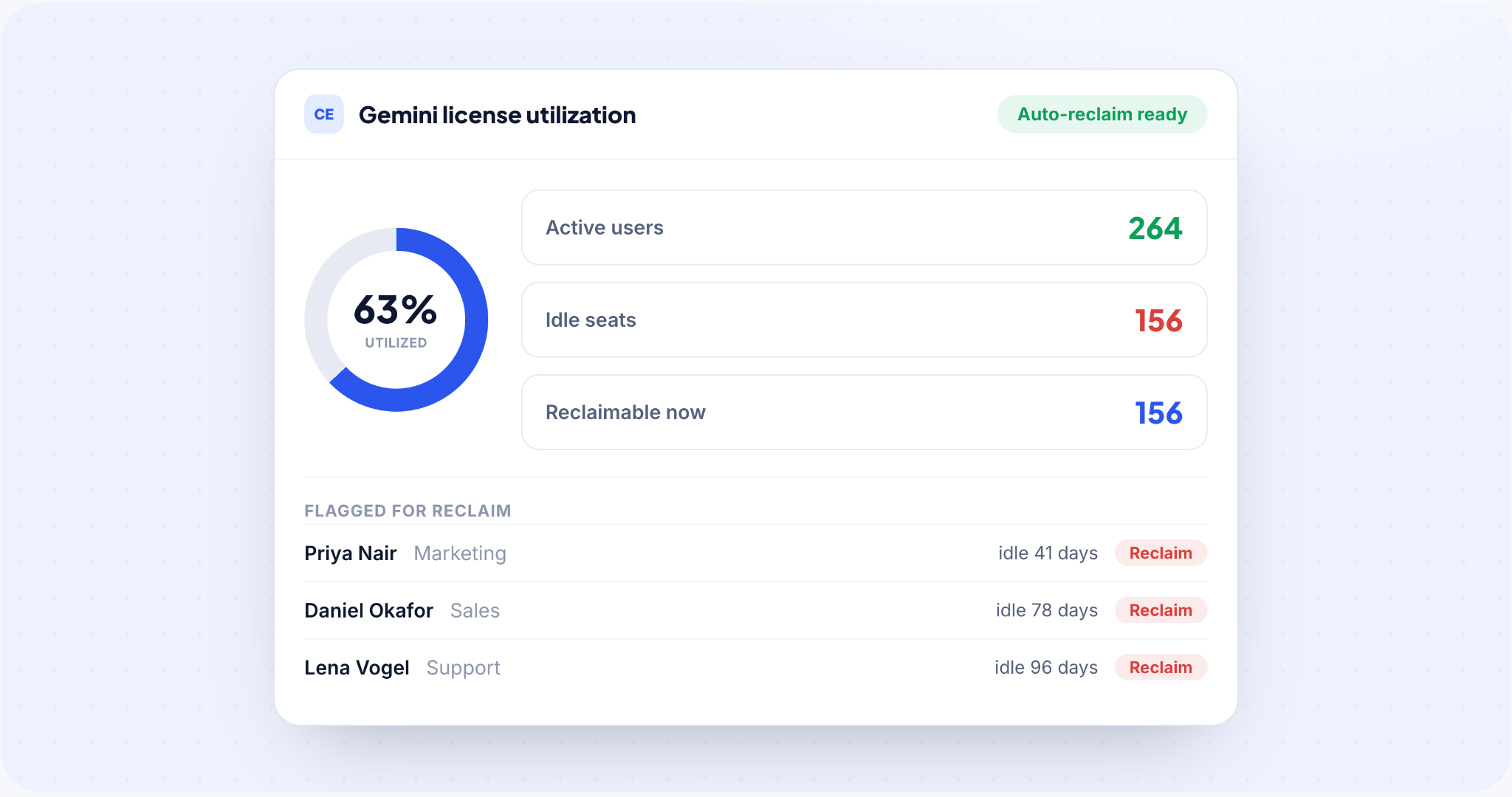
  • Reclaim idle seats. Pull active versus inactive users across Workspace and standalone subscriptions, and reclaim anything unopened in 30, 60, or 90 days before the next renewal.
  • Match the tier to real usage. Someone sitting on AI Ultra who could run on Pro, or on Pro but barely touching it, is spend you can move down a tier.
  • Catch the double-pay. A paid Gemini app subscription on top of the Gemini already bundled in that person's Workspace seat is the same tool billed twice.

CloudEagle.ai tracks all of this continuously and flags it between renewal cycles instead of once a year, so the cleanup happens while it still counts.
Track API and Token Spend by Team

A single Cloud invoice tells you the total. It does not tell you which team, project, or workflow drove it. Attributing token consumption by project turns an unexplained number into an owned one, and owned spend is spend someone can cut.

With CloudEagle.ai, that consumption shows up attributed by department and checked against the budget you set, so finance and engineering work from the same picture before the month closes.

Most teams don’t notice duplicate Gemini usage until renewal time. Read more →

Surface Shadow Gemini Across the Org

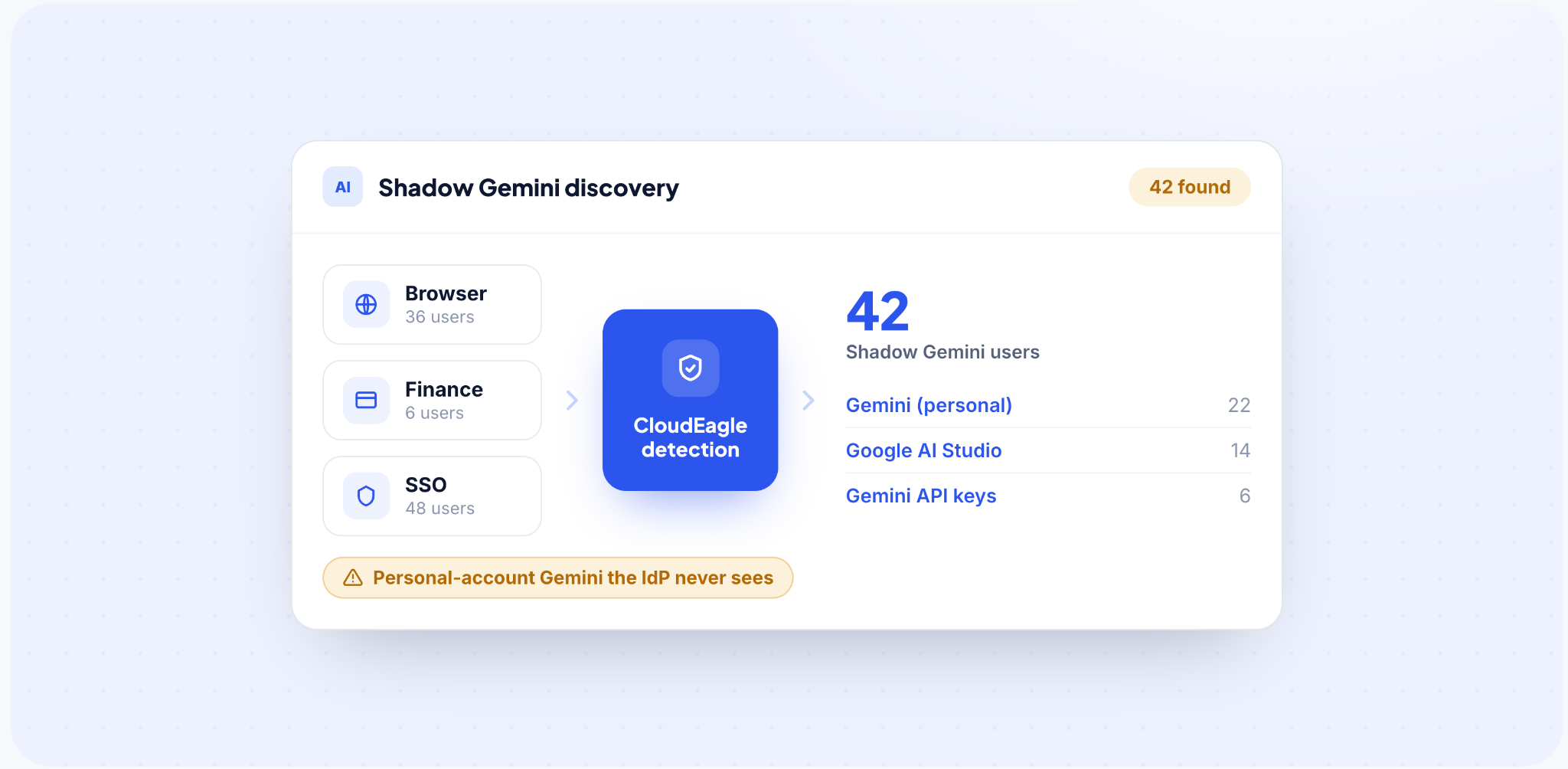
Most enterprises already have fragmented Gemini usage spread across Workspace seats, personal accounts, and raw API keys. 

We hear the same thing on calls: teams want to centralize Gemini tracking without blocking the people using it. That starts with the ability to discover shadow AI wherever it runs, not just the sanctioned seats.

CloudEagle.ai builds the inventory from across your stack, including the personal-account and browser signups that SSO never sees, and pulls that scattered usage into one view you can govern.
Match Gemini Access to Role with Automated Reviews

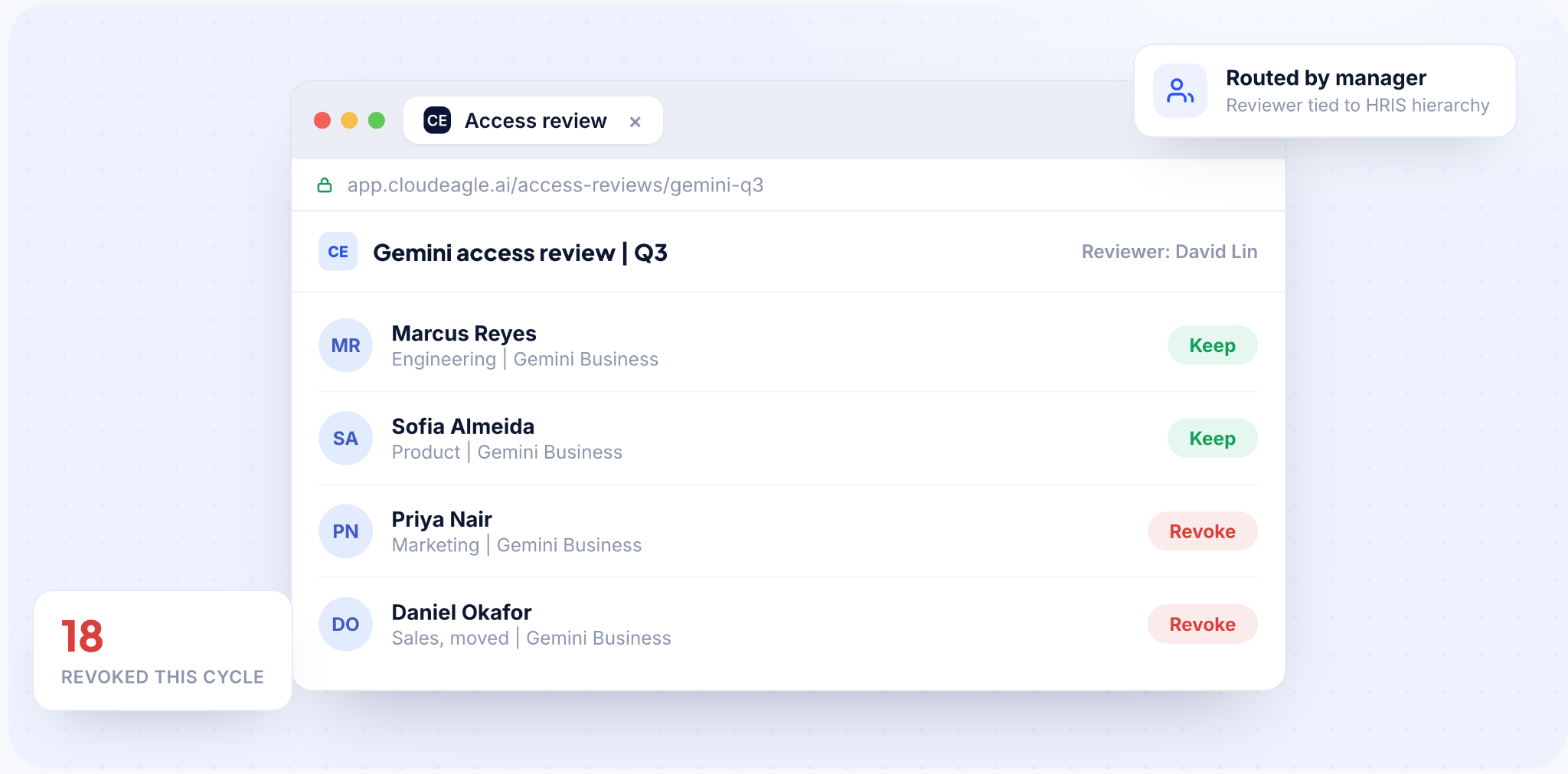
Access granted for one project often lingers for months after it ends, so you keep paying for a seat the person no longer needs. 

CloudEagle.ai runs access reviews that tie Gemini access to current role, which turns stale access into a reclaimed license on a schedule rather than by luck. 

It is part of why teams reach for CloudEagle.ai when they stand up AI governance across the enterprise.
Walk Into Renewals with Usage Data

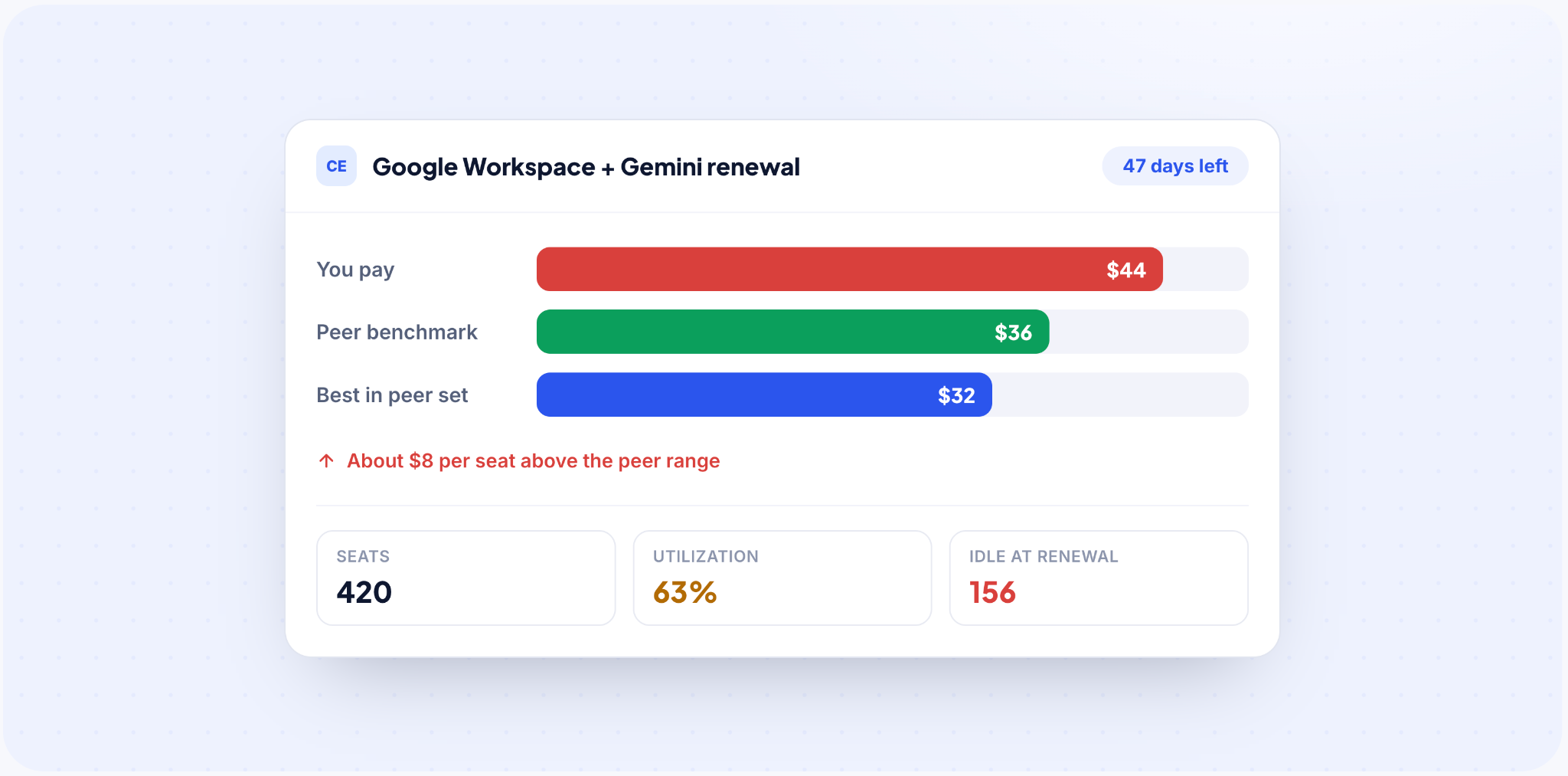
When the Gemini contract comes up, walk in guessing and you negotiate from the back foot. Walk in with utilization by team, the seats that went unused, and a benchmark for what comparable companies pay, and you set the terms. 

CloudEagle.ai arms the renewal with usage data and peer pricing so the seat count and the rate both reflect reality.
What Companies Actually Pay for Gemini

List price is where Google starts, not where companies land. The real Google Gemini pricing an enterprise pays moves on term length, volume, reseller choice, and how much Gemini you attach to your Workspace agreement. 

From CloudEagle.ai benchmark and community deal data, here are the levers that actually shift the number:

  • Buying through a reseller such as 66degrees or SADA tends to take 10 to 15 percent off list.
  • A 36-month commitment runs about 14 to 19 percent off.
  • Volume moves it most, up to 35 percent on Gemini at 500+ users and up to 50 percent at 3,500+ users.
  • There is an attach catch. Google now wants around 30 percent of your users on Gemini before it will discount Workspace, and Gemini is now bundled into Workspace rather than sold as an add-on.
  • As an anchor, Enterprise Plus lists around $36 per user per month with Gemini included.

These figures reflect benchmark and community deal data as of the most recent renewals tracked, so treat them as a starting range rather than a quote.

Every one of those levers runs on knowing your real usage. 

You cannot argue a seat count down without knowing which seats sit idle, and you cannot hit a volume tier intelligently while personal-account Gemini usage stays invisible. 

That is what AI governance and AI spend tracking give you. The same approach extends across the rest of your AI stack, not just Gemini, when you track Claude, Cursor, and Gemini spend in one place.

Best Practices to Reduce Gemini API and Token Spend

Subscription seats are the visible cost. Gemini API pricing is the one that scales fastest and warns you the least, because it bills per token and the rate depends on the model a developer points at. A few practices keep it in check:

Route routine work to the cheapest capable model

Model choice is the biggest driver of API cost. Send classification, summarization, and simple extraction to Flash or Flash-Lite, and reserve Pro for tasks that genuinely need deep reasoning.

Cache repeated context

Applications that resend the same large prompt prefix pay for those input tokens every time. Context caching reuses that content for a small storage fee. On Gemini 3.1 Pro, cached input runs about $0.20 per million tokens instead of $2, close to a 90 percent cut on every repeated prefix.

Batch non-urgent work

Jobs that are not time-sensitive run at roughly half price in batch mode.

Watch output and thinking tokens

Output costs several times more than input, and the newer Gemini models bill their internal reasoning as output too, so a verbose or over-reasoning prompt quietly multiplies the bill.

Stay under the context cliff

Gemini 3.1 Pro pricing roughly doubles above 200K tokens of context, so splitting a large job can cost less than sending it whole.

Set per-project budgets and alerts

Token spend rarely spikes loudly, so a threshold that trips in real time beats finding out when the invoice lands.

These practices work once you set them up. The harder part is keeping them true as new projects launch and teams change. 

CloudEagle.ai monitors API consumption against the budgets you set and attributes it back to the team that spent it, so token control holds as the environment shifts instead of depending on someone remembering to check.

Growing teams managing projects and collaboration workflows can also explore our Monday pricing guide when comparing productivity software investments.

How to Govern Shadow Gemini Access Across Teams

For security leaders, Gemini cost and Gemini risk are the same problem viewed from two angles. Both come back to who has access to what, and whether anyone is watching.

Access That Outlives the Role

The same stale access that wastes a license is also an open door. 

An account that keeps Gemini access after someone changes teams is standing privilege that no longer maps to a job, and at audit time that is exactly the kind of gap that draws a finding. 

Reviewing access on a cadence is what keeps privilege matched to role instead of accumulating in the background where no one is looking.

Sensitive Data Going into Prompts

Gemini reaches into Gmail, Docs, and Meet, which means employees can put regulated or confidential data into it without thinking of it as a data transfer. Without a policy and a way to enforce it, that exposure grows with adoption. 

Governing what data flows into AI tools is the part of the program that keeps a productivity win from becoming a compliance finding.

Bringing Personal and API Use Back Under Policy

Finding shadow Gemini is one problem. Governing it is the next one. Once that usage is visible, bringing it under the same rules as sanctioned use means moving personal-account activity onto governed corporate access and putting the same data and access policies around stray API keys.

Visibility makes the risk known. Policy is what actually retires it. Running that policy consistently across Gemini and the other AI tools in your stack is what the best AI governance platforms are built to do.

Bring Gemini Spend and Access Under One View

At enterprise scale, the right plan is the easy decision. The hard part is seeing every license, every token, and every point of access in one place, then acting on what you find before the bill or the audit forces the question. 

That is the layer CloudEagle.ai puts over your Gemini usage.
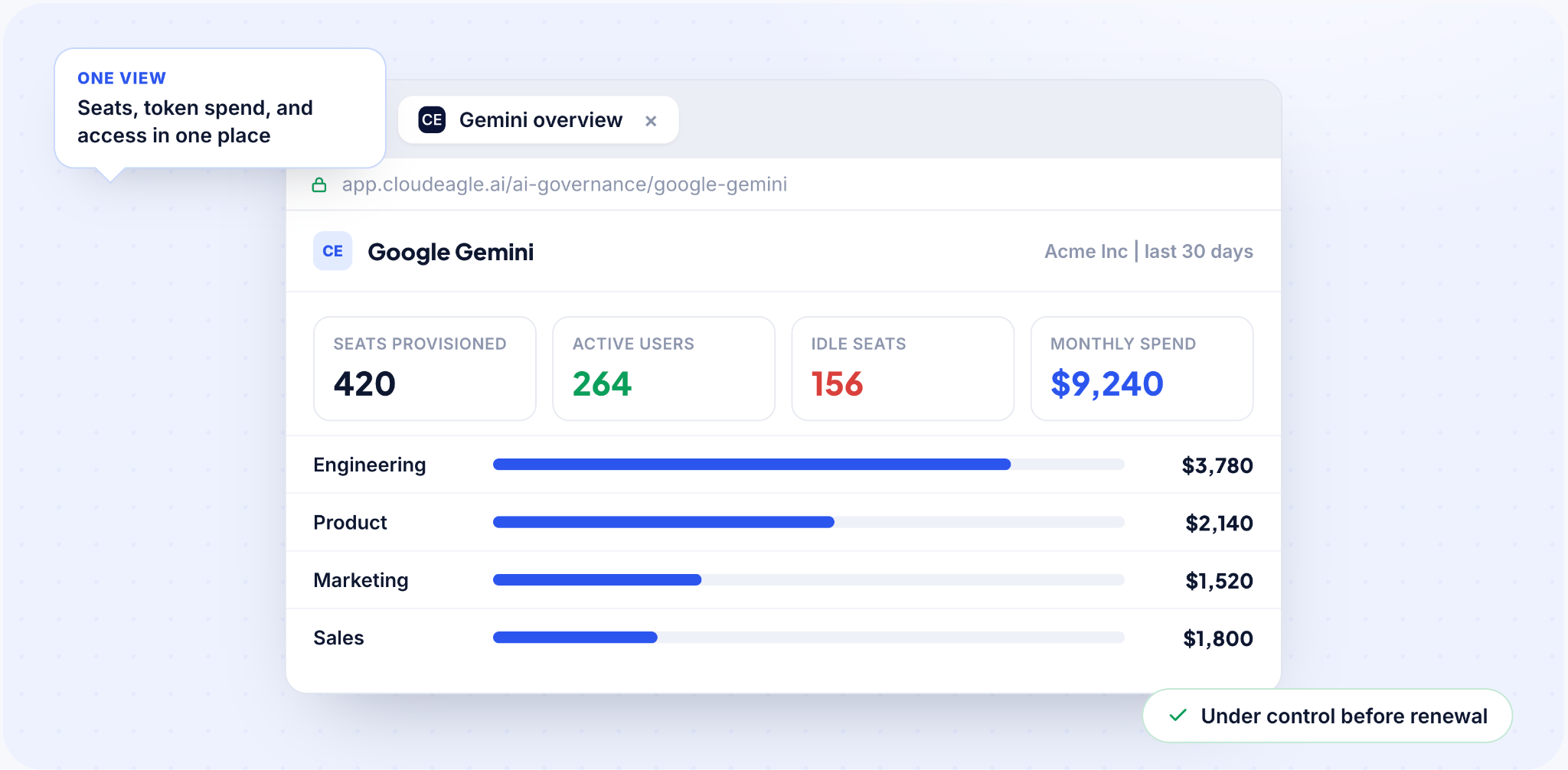
Book a demo to see how CloudEagle.ai brings Gemini spend and access under control.

Frequently Asked Questions 

Q1: How does CloudEagle.ai find Gemini usage that never goes through SSO?

CloudEagle.ai finds off-SSO Gemini by combining finance and expense data, browser signals, and direct integrations, not just your identity provider. That surfaces personal-account logins, browser signups, and stray API keys your SSO never sees, then pulls them into one inventory you can govern.

Q2: Does CloudEagle.ai connect to Google Workspace and Google Cloud directly?

CloudEagle.ai connects directly to Google Workspace, Google Cloud, your SSO, and finance systems, building one view of Gemini licenses, API spend, and access. From there it attributes token usage to the team that drove it and flags idle seats, with no spreadsheets to maintain.

Q3: Does CloudEagle.ai block employees from using Gemini, or govern it?

CloudEagle.ai governs Gemini rather than blocking it. It surfaces shadow usage, brings personal-account activity onto governed corporate access, and ties access to role through reviews, so people keep working while IT keeps control. It manages access and policy around the tool, not what anyone types into it.

Q4: Is it cheaper to use the Gemini API or buy Gemini seats?

Whether the Gemini API or per-seat plans are cheaper depends on usage. Interactive daily use is usually cheaper on a seat, while programmatic or bursty workloads often cost less on the pay-per-token API. The trap is running both without visibility, since idle seats and untracked tokens overlap.

Q5: If a Gemini seat sits unused, do you get refunded?

An unused Gemini seat usually keeps billing rather than refunding. Most Gemini and Workspace seats are committed for the term, so a dormant license runs until renewal. That is why catching idle seats before the renewal date matters, since renewal is when you can drop them without paying through the term.

Advertisement for a SaaS Subscription Tracking Template with a call-to-action button to download and a partial graphic of a tablet showing charts.Banner promoting a SaaS Agreement Checklist to streamline SaaS management and avoid budget waste with a call-to-action button labeled Download checklist.Blue banner with text 'The Ultimate Employee Offboarding Checklist!' and a black button labeled 'Download checklist' alongside partial views of checklist documents from cloudeagle.ai.Digital ad for download checklist titled 'The Ultimate Checklist for IT Leaders to Optimize SaaS Operations' by cloudeagle.ai, showing checklist pages.Slack Buyer's Guide offer with text 'Unlock insider insights to get the best deal on Slack!' and a button labeled 'Get Your Copy', accompanied by a preview of the guide featuring Slack's logo.Monday Pricing Guide by cloudeagle.ai offering exclusive pricing secrets to maximize investment with a call-to-action button labeled Get Your Copy and an image of the guide's cover.Blue banner for Canva Pricing Guide by cloudeagle.ai offering a guide to Canva costs, features, and alternatives with a call-to-action button saying Get Your Copy.Blue banner with white text reading 'Little-Known Negotiation Hacks to Get the Best Deal on Slack' and a white button labeled 'Get Your Copy'.Blue banner with text 'Little-Known Negotiation Hacks to Get the Best Deal on Monday.com' and a white button labeled 'Get Your Copy'.Blue banner with text 'Little-Known Negotiation Hacks to Get the Best Deal on Canva' and a white button labeled 'Get Your Copy'.Banner with text 'Slack Buyer's Guide' and a 'Download Now' button next to images of a guide titled 'Slack Buyer’s Guide: Features, Pricing & Best Practices'.Digital cover of Monday Pricing Guide with a button labeled Get Your Copy on a blue background.Canva Pricing Guide cover with a button labeled Get Your Copy on a blue gradient background.

Enter your email to
unlock the report

Oops! Something went wrong while submitting the form.
License Count
Benchmark
Per User/Per Year

Enter your email to
unlock the report

Oops! Something went wrong while submitting the form.
License Count
Benchmark
Per User/Per Year

Enter your email to
unlock the report

Oops! Something went wrong while submitting the form.
Notion Plus
License Count
Benchmark
Per User/Per Year
100-500
$67.20 - $78.72
500-1000
$59.52 - $72.00
1000+
$51.84 - $57.60
Canva Pro
License Count
Benchmark
Per User/Per Year
100-500
$74.33-$88.71
500-1000
$64.74-$80.32
1000+
$55.14-$62.34

Enter your email to
unlock the report

Oops! Something went wrong while submitting the form.

Enter your email to
unlock the report

Oops! Something went wrong while submitting the form.
Zoom Business
License Count
Benchmark
Per User/Per Year
100-500
$216.00 - $264.00
500-1000
$180.00 - $216.00
1000+
$156.00 - $180.00

Enter your email to
unlock the report

Oops! Something went wrong while submitting the form.

Get the Right Security Platform To Secure Your Cloud Infrastructure

Please enter a business email
Thank you!
The 2023 SaaS report has been sent to your email. Check your promotional or spam folder.
Oops! Something went wrong while submitting the form.

Access full report

Please enter a business email
Thank you!
The 2023 SaaS report has been sent to your email. Check your promotional or spam folder.
Oops! Something went wrong while submitting the form.

TL;DR

  • At enterprise scale, Google Gemini pricing is a governance problem, not a plan-selection problem. The plan price is the easy part.
  • The spend that hurts is unused seats, unwatched API tokens, and Gemini access nobody approved.
  • List price and what companies actually pay are different numbers. CloudEagle.ai benchmark data shows the levers that bring the rate down.
  • The fix is one view across licenses, token consumption, and shadow access, refreshed continuously instead of at renewal.
  • CloudEagle.ai is how enterprises get all three under control before the bill arrives.

At enterprise scale the question stops being which Gemini plan to buy. It becomes how to govern the spend once Gemini is already everywhere. The plan price is the smallest and most predictable line on your bill. 

What grows underneath it is harder to see: the licenses sitting idle and the API usage nobody can trace back to a team. That gap is the real story of Google Gemini pricing at scale, and this guide is about getting it under control.

Stop Overpaying for AI Tools

AI tools inflate spend fast. Control it.
Download Guide

Why Gemini Pricing Gets Harder to Control at Scale

The trouble with Gemini cost is not that any one number is high. It is that there are so many meters, and most of them run without anyone deciding to turn them on.

The Consumer Tiers Already Running Inside Your Org

The consumer side of Google Gemini pricing shows up inside your company whether you bought it or not. 

Google sells Gemini to individuals through Google One, and after Google reset the consumer plans at I/O 2026, the lineup tiers by usage limits and feature access, all running on Gemini 3.

  • Google AI Plus around $4.99 a month, with 400 GB of storage after a mid-2026 price cut. The entry paid tier for light personal use.
  • Google AI Pro around $19.99 a month. The mainstream paid plan, with higher limits and access to Deep Research.
  • Google AI Ultra from $99.99 a month, with a $200 top tier. Google cut both from $249.99 and $250 at I/O 2026. The highest limits and the most advanced models.

Employees expense these on personal cards or sign up with a work email, and the spend never touches a procurement workflow.

Gemini Pricing Gets Complicated Faster Than Most Teams Expect

Explore how usage tiers, enterprise access, and AI adoption patterns can quietly increase Gemini spend over time.
See Buyer Guide

Workspace Business and Enterprise Add Their Own Meters

Google has folded Gemini directly into Google Workspace, so the AI now rides inside Gmail, Docs, Sheets, and Meet rather than sitting beside them as a separate add-on.

The standalone Gemini add-on that used to cost $20 to $30 per user is gone. 

Google retired it in 2025 and raised the base plan prices instead, so Gemini now comes bundled into every paid tier. Current per-user pricing on annual billing:

  • Business Starter around $8 per user per month, with limited Gemini.
  • Business Standard around $14 per user per month.
  • Business Plus around $22 per user per month.
  • Enterprise custom-quoted, roughly $36 per user per month for Enterprise Plus per recent benchmark deal data.

The catch is that a Workspace seat assigns Gemini to a person whether or not that person ever opens it, so the meter runs on headcount, not adoption.

Where API and Token Pricing Turns Unpredictable

For anything built in-house, Gemini API pricing bills per token, and the rate depends on which model a developer points at. 

Output tokens cost several times more than input tokens, so verbose prompt design quietly multiplies the bill. 

Approximate current rates per one million tokens:

Model Input Output Best for
Gemini 3.1 Pro ~$2 ~$12 Flagship reasoning, large-context work
Gemini 3.5 Flash ~$1.50 ~$9 Everyday, balanced speed and cost
Gemini 3.1 Flash-Lite ~$0.25 ~$1.50 High-volume, cost-sensitive pipelines
Rates are per 1M tokens, from Google's Gemini API pricing. Gemini 3.1 Pro pricing roughly doubles above 200K tokens of context.

On top of the base rate sit context caching fees, grounding with Google Search priced as a separate meter, and image or audio generation billed on their own. 

One wrinkle worth catching early: Gemini 2.0 Flash was shut down on June 1, 2026, so any pipeline still pointed at it has already broken or migrated. 

Batch processing runs at roughly half price for work that is not time-sensitive.

Why You Pay for the Lineup You Bought Not the Usage You Got

Put those three tracks together and the pattern is clear. You are billed for the plans and seats and model access you provisioned, not for the usage you actually got. 

The gap between the two is where enterprise Gemini spend leaks, and no pricing page will show it to you because the pricing page only knows list price.

SaaS and AI Spend Calculator

CloudEagle.ai customers typically recover 10–30% of annual SaaS and AI spend. Answer 12 questions to benchmark your maturity, see your recoverable spend estimate, and get a personalized 3-page savings report.

12 questions · ~4 min 10–30% typical savings $2B+ saved across customers

No signup required to start · Instant results

Select “Save as PDF” in the print dialog to download your report.
SaaS & AI Spend Optimization Report  · 
Recoverable Spend Estimate

Maturity Score Breakdown
Overall Maturity
SaaS Maturity
AI Maturity
Optimization Areas Identified

Executive Summary
cloudeagle.ai Confidential 1 / 3
Your Optimization Gaps
Identified Optimization Gaps

The areas below scored 1 or 2 in your assessment. Each represents a specific gap where spend is leaking or optimization is being left on the table, with a clear first action to address it.

cloudeagle.ai Confidential 2 / 3
How CloudEagle.ai Can Help
Closing the Gap

CloudEagle.ai is the AI-powered command center for SaaS, AI, and identity governance. Trusted by RingCentral, Automation Anywhere, Shiji, and Rec Room, the platform has processed $20B+ in spend and delivered $2B+ in savings — typically 10–30% of annual SaaS and AI spend. The gaps surfaced in this report are exactly what CloudEagle was built to close.

Discover Every Tool — Including Shadow AI

Most organizations are governing a fraction of their actual SaaS and AI footprint. CloudEagle.ai builds a real-time inventory through 500+ direct integrations across SSO, finance, HRIS, browser, firewall, and contract data — surfacing every sanctioned tool, every shadow purchase, and every AI tool employees adopted without IT approval. Onboarding takes 30 minutes, with usable visibility from day one.


Eliminate Waste with Automated Optimization

Unused licenses, duplicate tools, and over-tiered subscriptions accumulate silently between renewal cycles. CloudEagle.ai runs continuous license harvesting, flags overlapping tools across departments, and arms renewals with peer pricing benchmarks and usage data — turning insights into action through no-code Slack-enabled workflows. Customers typically recover 10–30% of annual SaaS spend within the first 90 days.


Govern AI Spend Before It Becomes Ungovernable

AI tool costs are usage-based, token-driven, and largely invisible until invoices arrive. CloudEagle.ai tracks AI tool adoption across the organization, monitors usage against budget thresholds, enforces approval workflows for new AI tools, and detects sensitive content shared with public AI services — giving finance, IT, and security a shared real-time view before overruns hit the P&L.

Book a 30-Min Optimization Review

In a focused session with a CloudEagle.ai specialist, we map your specific spend profile against our optimization framework and show you exactly where your savings are — across unused licenses, duplicate tools, renewal negotiation leverage, and AI spend governance.

cloudeagle.ai/book-a-demo
cloudeagle.ai Confidential 3 / 3

How CloudEagle.ai Gets Gemini Spend Under Control

Gemini is rarely one line on your bill. People buy it on the app tiers, many already get it bundled inside their Workspace seat and pay for it twice, and developers run it through the API. 

Nobody is looking across all of it, and scattered is exactly where the waste hides.

So CloudEagle.ai works in that order. 

It discovers every place Gemini is being paid for, shows who actually uses it, then governs access and gets the spend under control. 

Each lever below closes part of that gap and works on its own. Run together, they compound, and that is what CloudEagle.ai automates.

Right-Size Licenses by Active and Inactive Users

Right-sizing Gemini is not just counting seats. Because Gemini is an AI tool and not a plain SaaS app, the waste hides in more than idle logins:

  • Reclaim idle seats. Pull active versus inactive users across Workspace and standalone subscriptions, and reclaim anything unopened in 30, 60, or 90 days before the next renewal.
  • Match the tier to real usage. Someone sitting on AI Ultra who could run on Pro, or on Pro but barely touching it, is spend you can move down a tier.
  • Catch the double-pay. A paid Gemini app subscription on top of the Gemini already bundled in that person's Workspace seat is the same tool billed twice.

CloudEagle.ai tracks all of this continuously and flags it between renewal cycles instead of once a year, so the cleanup happens while it still counts.

Track API and Token Spend by Team

A single Cloud invoice tells you the total. It does not tell you which team, project, or workflow drove it. Attributing token consumption by project turns an unexplained number into an owned one, and owned spend is spend someone can cut.

With CloudEagle.ai, that consumption shows up attributed by department and checked against the budget you set, so finance and engineering work from the same picture before the month closes.

Most teams don’t notice duplicate Gemini usage until renewal time. Read more →

Surface Shadow Gemini Across the Org

Most enterprises already have fragmented Gemini usage spread across Workspace seats, personal accounts, and raw API keys. 

We hear the same thing on calls: teams want to centralize Gemini tracking without blocking the people using it. That starts with the ability to discover shadow AI wherever it runs, not just the sanctioned seats.

CloudEagle.ai builds the inventory from across your stack, including the personal-account and browser signups that SSO never sees, and pulls that scattered usage into one view you can govern.

Match Gemini Access to Role with Automated Reviews

Access granted for one project often lingers for months after it ends, so you keep paying for a seat the person no longer needs. 

CloudEagle.ai runs access reviews that tie Gemini access to current role, which turns stale access into a reclaimed license on a schedule rather than by luck. 

It is part of why teams reach for CloudEagle.ai when they stand up AI governance across the enterprise.

Walk Into Renewals with Usage Data

When the Gemini contract comes up, walk in guessing and you negotiate from the back foot. Walk in with utilization by team, the seats that went unused, and a benchmark for what comparable companies pay, and you set the terms. 

CloudEagle.ai arms the renewal with usage data and peer pricing so the seat count and the rate both reflect reality.

What Companies Actually Pay for Gemini

List price is where Google starts, not where companies land. The real Google Gemini pricing an enterprise pays moves on term length, volume, reseller choice, and how much Gemini you attach to your Workspace agreement. 

From CloudEagle.ai benchmark and community deal data, here are the levers that actually shift the number:

  • Buying through a reseller such as 66degrees or SADA tends to take 10 to 15 percent off list.
  • A 36-month commitment runs about 14 to 19 percent off.
  • Volume moves it most, up to 35 percent on Gemini at 500+ users and up to 50 percent at 3,500+ users.
  • There is an attach catch. Google now wants around 30 percent of your users on Gemini before it will discount Workspace, and Gemini is now bundled into Workspace rather than sold as an add-on.
  • As an anchor, Enterprise Plus lists around $36 per user per month with Gemini included.

These figures reflect benchmark and community deal data as of the most recent renewals tracked, so treat them as a starting range rather than a quote.

Every one of those levers runs on knowing your real usage. 

You cannot argue a seat count down without knowing which seats sit idle, and you cannot hit a volume tier intelligently while personal-account Gemini usage stays invisible. 

That is what AI governance and AI spend tracking give you. The same approach extends across the rest of your AI stack, not just Gemini, when you track Claude, Cursor, and Gemini spend in one place.

Best Practices to Reduce Gemini API and Token Spend

Subscription seats are the visible cost. Gemini API pricing is the one that scales fastest and warns you the least, because it bills per token and the rate depends on the model a developer points at. A few practices keep it in check:

Route routine work to the cheapest capable model

Model choice is the biggest driver of API cost. Send classification, summarization, and simple extraction to Flash or Flash-Lite, and reserve Pro for tasks that genuinely need deep reasoning.

Cache repeated context

Applications that resend the same large prompt prefix pay for those input tokens every time. Context caching reuses that content for a small storage fee. On Gemini 3.1 Pro, cached input runs about $0.20 per million tokens instead of $2, close to a 90 percent cut on every repeated prefix.

Batch non-urgent work

Jobs that are not time-sensitive run at roughly half price in batch mode.

Watch output and thinking tokens

Output costs several times more than input, and the newer Gemini models bill their internal reasoning as output too, so a verbose or over-reasoning prompt quietly multiplies the bill.

Stay under the context cliff

Gemini 3.1 Pro pricing roughly doubles above 200K tokens of context, so splitting a large job can cost less than sending it whole.

Set per-project budgets and alerts

Token spend rarely spikes loudly, so a threshold that trips in real time beats finding out when the invoice lands.

These practices work once you set them up. The harder part is keeping them true as new projects launch and teams change. 

CloudEagle.ai monitors API consumption against the budgets you set and attributes it back to the team that spent it, so token control holds as the environment shifts instead of depending on someone remembering to check.

Growing teams managing projects and collaboration workflows can also explore our Monday pricing guide when comparing productivity software investments.

How to Govern Shadow Gemini Access Across Teams

For security leaders, Gemini cost and Gemini risk are the same problem viewed from two angles. Both come back to who has access to what, and whether anyone is watching.

Access That Outlives the Role

The same stale access that wastes a license is also an open door. 

An account that keeps Gemini access after someone changes teams is standing privilege that no longer maps to a job, and at audit time that is exactly the kind of gap that draws a finding. 

Reviewing access on a cadence is what keeps privilege matched to role instead of accumulating in the background where no one is looking.

Sensitive Data Going into Prompts

Gemini reaches into Gmail, Docs, and Meet, which means employees can put regulated or confidential data into it without thinking of it as a data transfer. Without a policy and a way to enforce it, that exposure grows with adoption. 

Governing what data flows into AI tools is the part of the program that keeps a productivity win from becoming a compliance finding.

Bringing Personal and API Use Back Under Policy

Finding shadow Gemini is one problem. Governing it is the next one. Once that usage is visible, bringing it under the same rules as sanctioned use means moving personal-account activity onto governed corporate access and putting the same data and access policies around stray API keys.

Visibility makes the risk known. Policy is what actually retires it. Running that policy consistently across Gemini and the other AI tools in your stack is what the best AI governance platforms are built to do.

Bring Gemini Spend and Access Under One View

At enterprise scale, the right plan is the easy decision. The hard part is seeing every license, every token, and every point of access in one place, then acting on what you find before the bill or the audit forces the question. 

That is the layer CloudEagle.ai puts over your Gemini usage.

Book a demo to see how CloudEagle.ai brings Gemini spend and access under control.

Frequently Asked Questions 

Q1: How does CloudEagle.ai find Gemini usage that never goes through SSO?

CloudEagle.ai finds off-SSO Gemini by combining finance and expense data, browser signals, and direct integrations, not just your identity provider. That surfaces personal-account logins, browser signups, and stray API keys your SSO never sees, then pulls them into one inventory you can govern.

Q2: Does CloudEagle.ai connect to Google Workspace and Google Cloud directly?

CloudEagle.ai connects directly to Google Workspace, Google Cloud, your SSO, and finance systems, building one view of Gemini licenses, API spend, and access. From there it attributes token usage to the team that drove it and flags idle seats, with no spreadsheets to maintain.

Q3: Does CloudEagle.ai block employees from using Gemini, or govern it?

CloudEagle.ai governs Gemini rather than blocking it. It surfaces shadow usage, brings personal-account activity onto governed corporate access, and ties access to role through reviews, so people keep working while IT keeps control. It manages access and policy around the tool, not what anyone types into it.

Q4: Is it cheaper to use the Gemini API or buy Gemini seats?

Whether the Gemini API or per-seat plans are cheaper depends on usage. Interactive daily use is usually cheaper on a seat, while programmatic or bursty workloads often cost less on the pay-per-token API. The trap is running both without visibility, since idle seats and untracked tokens overlap.

Q5: If a Gemini seat sits unused, do you get refunded?

An unused Gemini seat usually keeps billing rather than refunding. Most Gemini and Workspace seats are committed for the term, so a dormant license runs until renewal. That is why catching idle seats before the renewal date matters, since renewal is when you can drop them without paying through the term.

CloudEagle.ai recognized in the 2025 Gartner® Magic Quadrant™ for SaaS Management Platforms
Download now
gartner chart
5x
Faster employee
onboarding
80%
Reduction in time for
user access reviews
30k
Workflows
automated
$15Bn
Analyzed in
contract spend
$2Bn
Saved in
SaaS spend

Streamline SaaS governance and save 10-30%

Book a Demo with Expert
CTA image