%201.svg)


HIPAA Compliance Checklist for 2025

Contract chaos is real, especially for enterprises managing hundreds or thousands of vendor agreements, renewals, NDAs, SLAs, and legal documents.
According to Gartner, 65% of organizations struggle to locate critical contracts when needed, and compliance failures linked to poor contract visibility can cost companies up to 9% of annual revenue.
That’s why more organizations are moving to modern contract repository tools, centralized platforms that store, search, secure, and automate contract lifecycle workflows.
In this guide, we break down what a contract repository is, why it matters, and the 7 best contract repository tools built for modern procurement and legal teams.
TL;DR
- Contract repository tools centralize contracts, automate renewals, and improve visibility.
- They reduce financial risk and eliminate missed deadlines or lost documents.
- CloudEagle.ai leads with end-to-end vendor and contract lifecycle automation.
- Top alternatives include DocuSign CLM, ContractWorks, Ironclad, and Agiloft.
- A digital repository is now essential, not optional, for scaling organizations.
1. Contract Repository Tools: Why Centralized Storage Is No Longer Optional
A contract repository tool is a cloud-based system that stores, organizes, tracks, and manages business contracts in a secure digital environment.
Unlike shared drives, spreadsheets, or manual filing systems, a digital contract repository centralizes all agreements in one searchable database with full audit trails, permissions, and version history.
Typical functionality of contract repository tools includes:
- Centralized storage for all contract documents and metadata
- Search, tagging, and filtering for fast retrieval
- Access control and permissions based on roles or departments
- Version management and audit history
- Renewal and expiration tracking
The global contract repository software market hit USD 1.45 billion in 2024 and is forecast to grow rapidly, reflecting the rising importance of digital contract management.
Types of Contract Repository Tools
Not all contract repository tools are built the same. Most fall into four categories:
- Standalone Contract Repository Software
Focused purely on secure storage, search, permissions, and renewal tracking. Simple to deploy, but limited automation. - CLM-Embedded Repositories
Built into contract lifecycle management platforms. Strong workflow automation and governance, higher cost, and setup. - ERP or Procurement-Suite Repositories
Integrated within systems like SAP Ariba or Coupa. Great for procurement-heavy teams but often rigid and expensive. - Shared Drives with Add-Ons
Google Drive or SharePoint setups with manual controls. Low upfront cost but weak governance and scalability.
2. How Contract Repository Software Actually Works Behind the Scenes?
Contract repository tools connect contract storage, metadata, search, timelines, and access controls into one unified system.
They eliminate the manual work associated with tracking agreements scattered across email or shared drives.
They work by:
- Centralizing all contracts in a secure, cloud-based repository
- Indexing and tagging metadata for instant search and retrieval
- Automating reminders and renewals to prevent last-minute negotiations
- Controlling permissions to enforce compliance and mitigate risk
- Providing a single source of truth across legal, procurement, and finance teams
Automated tracking is critical; studies show that automated renewal alerts reduce missed renewal deadlines by up to 80%, protecting companies from auto-renewal penalties and compliance risks.

3. What Is the Real Cost of Poor Contract Management?
Most blogs mention the 9% revenue loss and move on.
Let’s break down what that actually looks like.
Poor visibility inside your contract repository leads to:
- Missed auto-renewal opt-outs
- Contracts renewing at outdated pricing
- Overlapping vendor agreements
- Unenforced SLA penalties
- Compliance fines for missed obligations
When 65% of teams struggle to find contracts, procurement negotiates without leverage, and finance absorbs the loss.
This is why modern contract repository tools are not about storage.
They are about revenue protection.
4. What Are the Best Contract Repository Features to Look for?
The best contract repository software goes beyond basic digital storage. Modern platforms combine automation, visibility, and security to help organizations manage every contract efficiently throughout its lifecycle.
Here are the essential capabilities to look for when evaluating contract repository tools:
1. Centralized Digital Storage
Provides a secure, unified space to store and organize contracts across all departments.
Benefits:
- Prevents contract scattering across SharePoint, email, and drives
- Offers a single source of truth for procurement, finance, and legal
- Improves document traceability and version control
92% of organizations say contracts are hard to track and manage when stored across multiple systems.
This is the core of every powerful digital contract repository.
2. Advanced Search and Intelligent Tagging
Allows users to find any contract instantly using metadata, keywords, OCR text search, and filters.
Benefits:
- Saves hours wasted on locating critical agreements
- Makes audits and legal reviews faster
- Enables contract insights that drive better decision-making
3. Version Control and Access Permissions
Ensures contract edits, uploads, and approvals are fully tracked and secured.
Benefits:
- Protects sensitive legal and vendor information
- Prevents unauthorized contract access or edits
- Maintains a complete audit trail of every update
4. Integration with Procurement, Finance & CLM Systems
Connects contract systems with CLM, ERP, CRM, SaaS, and procurement tools.
Benefits:
- Eliminates duplicate data entry
- Ensures real-time syncing of agreements
- Improves collaboration between legal, finance, IT & procurement
5. 7 Best Contract Repository Tools Worth Considering in 2026
Here are the top platforms for modern contract storage and lifecycle automation, starting with CloudEagle.ai.
1. CloudEagle.ai
CloudEagle.ai is an AI-powered procurement and SaaS lifecycle platform that includes one of the most advanced contract repository tools for enterprises. It centralizes every contract, connects usage and spend insights, and automates renewal workflows, giving procurement, finance, and IT complete control over vendor agreements.
Unlike traditional storage tools, CloudEagle ties contract intelligenceto real SaaS usage and financial data, enabling data-backed negotiations and eliminating costly renewal surprises.
Features-
1. Centralized Storage for All Contracts
Stores all vendor and SaaS agreements in a single secure repository, eliminating scattered files across email, Google Drive, SharePoint, and inboxes.

Benefits:
- Instant access to the latest contract version
- Fully searchable and auditable structure
- Consolidated repository for vendor data and documents
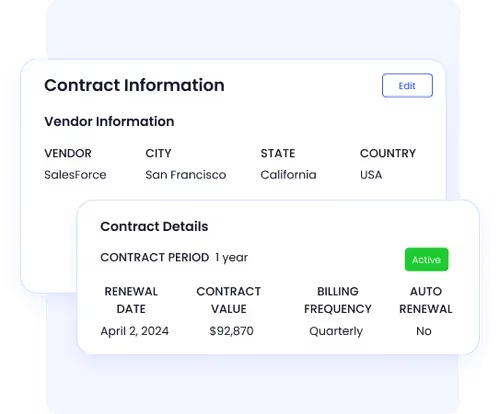
2. AI-Powered Metadata Extraction
This AI metadata extraction automatically extracts renewal dates, notice periods, opt-out deadlines, license counts, SKUs, payment terms, and more.
Benefits:
- Eliminates manual contract data entry
- Reduces human error and time spent reviewing documents
- Ensures complete, clean contract intelligence
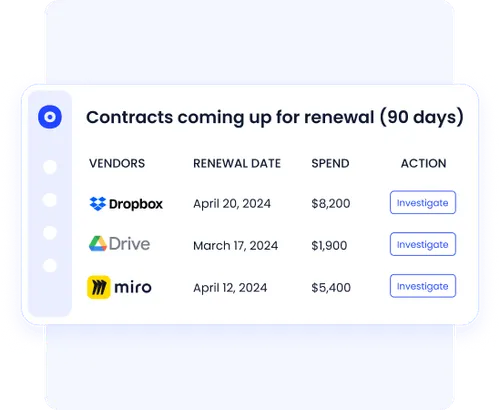
3. Automated Renewal Calendar
Auto-populatedrenewal dashboard based on extracted metadata.
Benefits:
- Real-time visibility into upcoming renewals
- Alerts before cancellation windows close
- Prevents painful surprise renewals
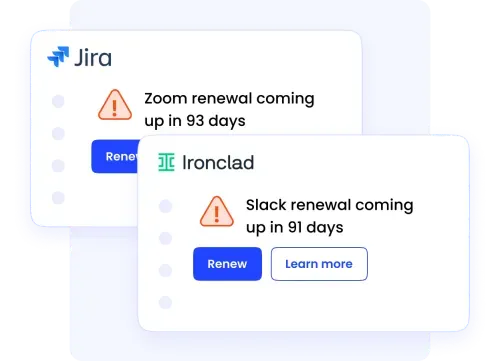
4. Integrations With CLM & Procurement Systems
Connects with Ironclad, Coupa, Zip, and others through bidirectional syncing.
Benefits:
- Always-up-to-date documents
- Eliminates manual upload & tracking
- Streamlines contracting workflows
5. Contract + Usage + Spend Intelligence
Links contracts to usage data, license counts, SKUs, and spend metrics using CloudEagle’s proprietary SaaSMap.
Benefits:
- Smarter renewal decision-making
- Identifies unused or overpurchased licenses
- Drives fact-based negotiation outcomes
6. Renewal Negotiation Support & Insights
Price benchmarkingidentifies savings and enables license reclamation.
Benefits:
- Reduces SaaS overspend significantly
- Enables procurement to negotiate from strength
- Supports continuous optimization lifecycle
Pricing
Custom quote based on contract volume, integrations, and automation scope. Typical range $5,000–$50,000+/year.
Modern Contract Management Starts Here.


2. DocuSign CLM
DocuSign CLM is an enterprise-grade contract lifecycle management tool known for its strong workflow automation and integration with DocuSign eSignature.

It is widely used by legal and procurement teams looking to streamline contract routing and approvals. While powerful, it focuses more on workflow automation than deep contract storage solutions.
Features
- Workflow and approval automation
- Central contract repository
- Template and clause library
- Integration with ERP and CRM platforms
Limitations
- Complex setup and steep learning curve
- Higher pricing for advanced functionality
Pricing
Custom enterprise pricing.
3. ContractWorks
ContractWorks is a simple, easy-to-deploy best contract repository software option designed for teams needing fast implementation without complexity.

It focuses on secure storage, advanced search, e-signature, and automated reminders, ideal for growing organizations.
Features
- Secure centralized contract repository
- Automated alerts for key dates
- AI-powered search and tagging
- Built-in e-signature capability
Limitations
- Limited workflow automation
- Not ideal for large enterprise scalability
Pricing
Starts around $700/month.
4. Ironclad
Ironclad is a modern CLM platform built for high-volume digital contracting. It combines contract creation, redlining, approval routing, and repository functionality.
Popular among legal teams, Ironclad is strongfor negotiationworkflows and collaboration.
Features
- Dynamic workflow builder
- Contract repository with full audit history
- Redlining and collaboration tools
- Integrations with Salesforce and Google Drive
Limitations
- Pricing is on the higher side
- Can be complex for basic contract storage use cases
Pricing
Custom pricing based on contract volume.
5. PandaDoc
PandaDoc is a document workflow and e-signature platform used widely for sales agreements, proposals, and customer-facing documents.

It includes a digital contract repository, enabling teams to store and organize finalized contracts securely.
Features
- Central contract storage
- Real-time document tracking
- Template and e-signature library
- Collaboration and commenting tools
Limitations
- More sales-focused than procurement/legal
- Limited enterprise governance functionality
Pricing
Starts at $19/user/month.
6. Agiloft
Agiloft is a flexible and customizable contract management software platform designed for complex enterprise workflows.

It supports configurable automation, approvals, and repository structure.
Features
- Highly customizable contract repository
- Advanced workflow automation
- Clause library and redlining
- AI analytics and reporting tools
Limitations
- Requires setup time and admin training
- UI is not as modern as its competitors
Pricing
Custom enterprise pricing.
7. Concord
Concord is a cloud-based contract storage solution built for collaboration and centralized control.
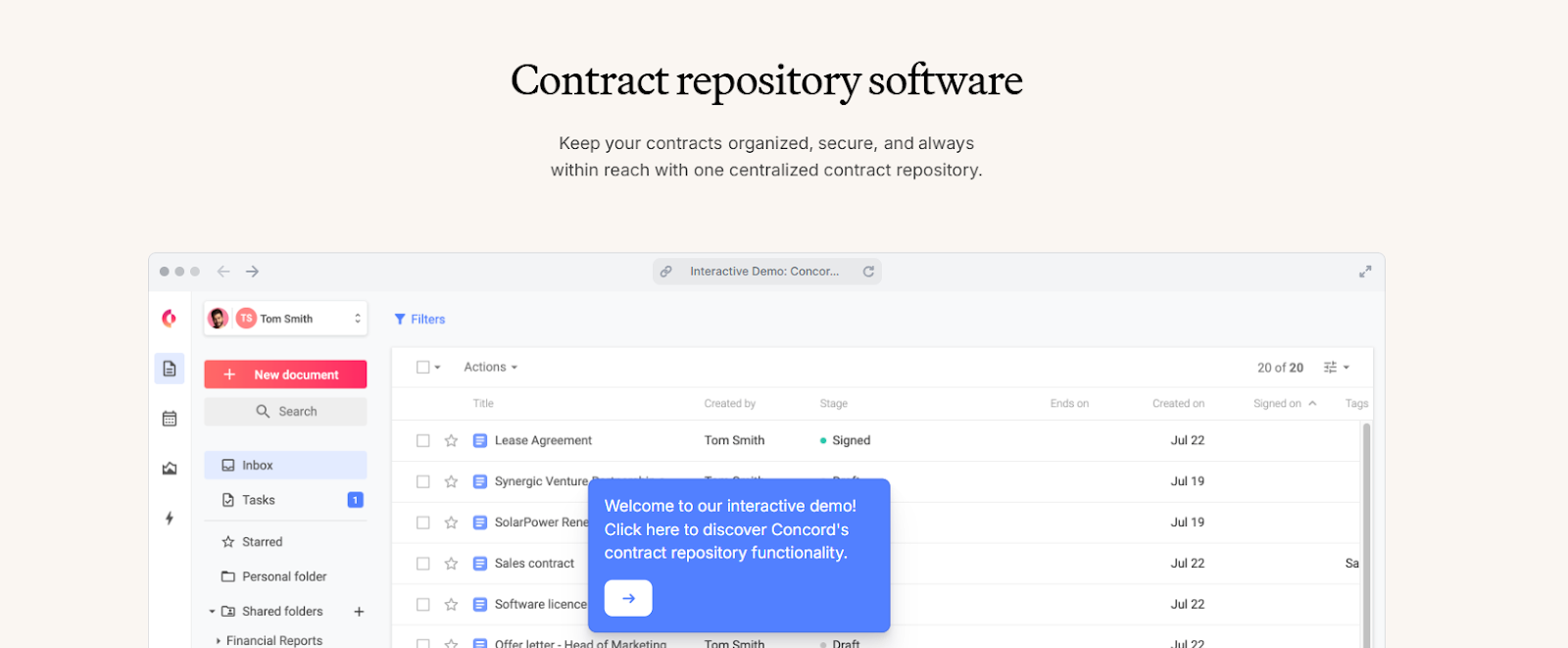
It offers unlimited e-signatures, version tracking, and audit trails, making it attractive for teams focused on simplicity and speed.
Features
- Unlimited e-signatures
- Centralized contract storage
- Real-time collaboration and approvals
- Renewal tracking and reminders
Limitations
- Limited analytics depth
- Basic reporting compared to larger platforms
Pricing
Paid plans starting at $23/user/month.
6. Contract Repository vs. Full CLM: Which One Do You Actually Need?
Buyers often confuse a contract repository with full contract lifecycle management. The right choice depends on whether your problem is visibility or workflow automation.
Contract Repository focuses on:
- Centralized storage and search
- Renewal and expiration tracking
- Role-based access control
- Basic reporting and audit trails
Full CLM includes:
- Drafting and clause libraries
- Redlining and collaboration
- Approval workflows
- End-to-end lifecycle automation
If you need control and renewal visibility, strong contract repository tools may be enough. If legal bottlenecks slow you down, CLM is the better fit.
7. How a Contract Repository Connects to SaaS Spend and Vendor Negotiations
Most vendors treat a contract repository as storage. Procurement teams should treat it as leverage.
When contract metadata connects to spend and usage insights, teams can:
- Identify underused licenses before renewal
- Track notice periods and opt-out windows
- Benchmark vendor pricing
- Surface overlapping or duplicate contracts
- Enter negotiations with data, not assumptions
Modern contract repository software turns agreements into actionable procurement intelligence.
8. How to Migrate Your Existing Contracts Into a Repository
Migration sounds complex, but modern contract repository tools are built to simplify it.
Implementation typically includes:
- Bulk uploads from shared drives and email exports
- AI-based metadata extraction from existing PDFs
- Automatic tagging of renewal dates and vendors
- Phased rollout starting with high-value contracts
You do not re-enter contracts manually. A structured central contract repository can be live in weeks, not months.
9. What’s the Best Contract Repository for Small Businesses?
For small businesses, the right contract repository software should deliver visibility in days, not months, without heavy IT involvement or long implementation cycles.
Evaluate platforms against these key criteria:
- Time-to-value: Choose tools with bulk ingestion and OCR-based auto-tagging. If setup takes weeks, it slows you down.
- Low admin overhead: Self-serve configuration and automated renewal reminders reduce ongoing effort.
- Essential security: RBAC and a full audit trail are non-negotiable to prevent compliance risk.
- Renewal intelligence: Alerts should be tied to extracted contract metadata, not just calendar dates, to prevent auto-renewal spend leakage.
- Core integrations: Native connections to e-signature, finance, and communication tools keep contracts synchronized.
Avoid three common pitfalls: adopting siloed point tools that create sprawl, relying on login-only visibility that misses renewal risks, and choosing affordable contract management software with repository features that lack granular permissions.
10. What Are the Benefits of Using a Contract Repository Tool?
Adopting a modern contract management software platform transforms how teams manage agreements, streamline approvals, and avoid costly errors. Here are the core advantages organizations gain from switching to automated contract repository tools:
1. Improved Contract Visibility and Compliance
- Complete visibility into vendor agreements, SLAs, renewals, and amendments
- Reduced compliance risk with controlled access and audit history
- Clear ownership and accountability across departments
Companies using centralized contract repository tools report a 50% reduction in contract cycle time and 25% lower administrative effort, proving the ROI of structured digital storage.
2. Faster Retrieval and Reduced Manual Tracking
- Quick search instead of searching through folders or email threads
- Automated workflows remove spreadsheets and manual reminders
- Less admin work for legal, finance, and procurement
Teams spend less time searching and more time executing.
3. Secure, Centralized Cloud-Based Access
- Role-based permissions and encryption by default
- Controlled access for internal teams & external partners
- Secure access from any location and device
A cloud repository offers far more resilience and safety than static storage.
In A Nutshell
Growing businesses need more than shared folders and spreadsheets to manage contracts effectively. As contract volume increases, so do compliance risks, financial exposure, and operational inefficiencies. A modern contract repository system gives organizations structure, visibility, and control.
The best contract repository tools centralize all agreements, automate renewals, and improve cross-department collaboration, reducing manual work and preventing costly mistakes. For enterprises seeking smarter contract management, automation and visibility are now essential.
CloudEagle.aistands out as the most comprehensive platform for contract storage, SaaS vendor lifecycle management, spend intelligence, and automation, giving teams a single place to store, track, negotiate, and optimize every contract across the business.
Book a free demo today and streamline contract storage.
Frequently Asked Questions
1. How is a contract repository different from contract management software?
A contract repository is focused on securely storing, organizing, and retrieving contracts, while contract management software (CLM) manages the full lifecycle, creation, approvals, redlining, negotiations, signatures, and renewals.
2. How do digital repositories help secure legal contracts?
Digital contract repositories secure contracts using encryption, role-based access, version control, and audit trails, preventing unauthorized access and ensuring compliance with legal and regulatory requirements.
3. How does a cloud-based contract repository improve accessibility?
It allows teams to access contracts from anywhere with real-time search, tagging, and permissions. Cloud storage ensures faster retrieval, better collaboration, and eliminates dependency on local drives or email archives.
4. What is a CLM tool?
A CLM (Contract Lifecycle Management) tool manages the entire contract process, from drafting and collaboration to approval, signature, storage, and renewal, automating workflows and improving legal and procurement efficiency.
5. What’s the difference between CLM and CRM?
CLM manages business contracts and legal agreements, while CRM manages customer relationships, sales pipelines, and interactions. CRM tracks customer activity; CLM governs contract creation, approval, storage, and compliance.
Modern Contract Management Starts Here.


.avif)


.avif)
.avif)




.png)